Showing posts with label trinity. Show all posts

Tuesday, March 5, 2013

The Rublev Trinity Icon

I'm going to put in a short, good word on behalf of the excellent book by Heiromonk Gabriel Bunge, The Rublev Trinity. In the book, Bunge traces the historical development of the iconographical tradition of Genesis 18, or the Hospitality of Abraham, beginning in the 4th century and culminating in the 14th century with the Russian monk Andrei Rublev's famous icon. Due to the iconoclasm of the 7th and 8th centuries, the extant icons from the first millennium are very limited in number, but they still provide a sense of the various contours of the tradition.

Broadly speaking, the tradition goes from angelological to christological to trinitarian. The visitors are originally portrayed as simply three angels who visit Abraham; as the tradition develops, the central angel begins to be distinguished as a type of Christ; and finally the tradition comes to full fruition by reading the episode as a typographical appearance of the Holy Trinity. 

To refresh your memory, in Genesis 18 Abraham and Sarah are visited by three men, one of whom is called "Lord" by Abraham, and who Abraham and Sarah show hospitality by preparing a meal -- bread and a calf -- for. The Lord goes on to tell Sarah that she will bear a child in her old age, and then reveals to Abraham the coming fate of Sodom of Gomorrah. 

Some of the earliest frescoes show the three visitors as angels and as essentially identical, or as slightly different but not in any manner distinguishing one as more significant than the other two. 


By the 5th century, certain distinctly christological elements begin to arise. A mosaic from San Vitale, Ravenna (pictured above), placed in the sanctuary of the Church, reveals  that the scene is being understood as an Old Testament type of the Eucharist. This is due both to the elements of the icon itself (the calf in the dish, as a type of Christ, the Lamb that was slain "from before the foundation of the world."), as well as its placement within the Church space: in the alter area (where the Holy Gifts are prepared)  and adjacent to depictions of the sacrifices of Abel and Melchisdec. This is significant because, according to the Epistle to the Hebrews, "Christ is both simultaneously the sacrifice and the priest: prefigured in Abel (cf. Heb 12:24), Melchisdec (Heb passim), and Isaac (Heb 11.19)." In this icon, the three angels are portrayed as almost identical to each other, with no real distinguishing features.

As the iconographical tradition develops, it begins to single out one of the angels as distinctly representing Christ, while the other two are reduced to angelic companions. This is done by changing the color of the central angel's nimbus to red, then by including a cross within the nimbus and depicting him as much larger than the other two angels, and later by dressing him the way that Christ is usually depicted as dressing in iconography. 

(Again, I'm outlining the iconographical tradition in extremely broad, inelegant strokes. For the full picture, please read this excellent text.)

A Trinitarian type of depiction begins to take shape long before Andrei Rublev's definitive icon is written, as many icons of the Hospitality of Abraham began to bear the title "The Holy Trinity", along with the depictions themselves becoming more trinitarian. But to save space I want to skip straight to Rublev's icon and discuss it some, with the guidance of Heiromonk Bunge.
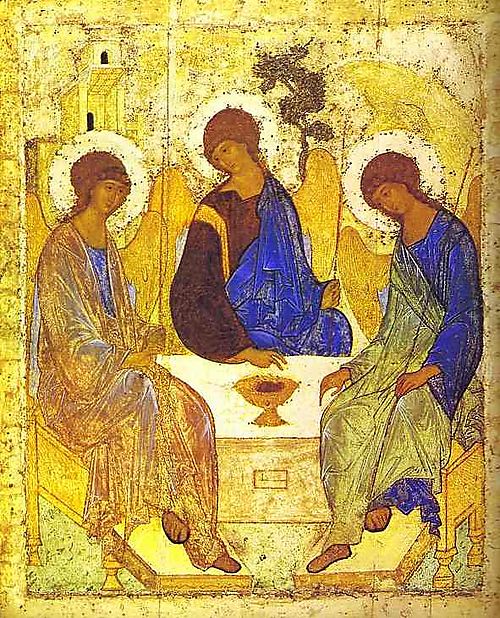

During the development of the tradition, Abraham and Sarah were depicted for a long time, but in Rublev's icon they are no longer there. The observer takes their place as he gazes upon a type of the mystery of the Holy Trinity, and is invited to become a partaker in the inter-Trinitarian life that opens up to him by way of the Eucharist. Because the icon is a festal icon for Pentecost, Bunge reads the icon as a pictorial representation of Christ's Farewell Discourse in John 14-20, which "is completely shot through with the mystery, now being revealed, of the Triune God." 

In that discourse, Our Lord begins by telling his disciples that in His "Father's house are many rooms; if it were not so, would I have told you that I go to prepare a place for you?" Note the house in the background of the icon, which aligns with the figure on the left. This is one indication that the figure on the left is to be read as a type of the Father, which becomes more certain the more we contemplate the icon.

Rublev follows in the iconographical tradition that identifies the central angel as the Son. This is made clear by his dress, which is the same as that of Christ in most iconography. In addition to this, a vertical line through the center of the icon aligns the central figure with the calf in the chalice, as well as the tree in the background, which Bunge reads as an image of the Tree of Life and the Cross. Another visual cue is that the outlines of the bodies of the outer angels form a second chalice, within which the central angel sits, further deepening the Eucharistic theme.

One interesting thing that I learned from this book is that, in the process of recovering the icon from being painted over, one of the two fingers of the central angel was added on later. Originally, the only finger extended was that which now appears to be the middle finger, but is actually the index finger. This is significant because the gesture of the central figure is actually pointing at the chalice, and past it to the third figure, the angel on the right that represents the Holy Spirit. 

The angel on the left inclines his head toward neither of the other two, while they both incline theirs in the same angle toward him. This is a visual depiction of the fact that, in concert with orthodox Trinitarianism, the Father is the fountainhead -- the monarchia -- of being, from whom the Son is eternally begotten and from whom the Spirit eternally proceeds. 

Further, the figure on the left is clothed such that no arm is 'free', while the Christ-figure's right arm is uncovered, and the Holy Spirit's left arm is. This is another means for distinguishing the figures, and draws on the venerable, orthodox formula of St. Irenaeus of Lyons that says that Christ and the Spirit are the Father's "two hands" who do the Father's work within salvation history. 

The gestures of each further indicate truths about the inter-Trinitarian life that Bunge more thoroughly explicates.

Bunge also points out that, while the table with the chalice on it is obviously a type of the alter and the Eucharist, the perspective is reversed. That is, we aren't looking into the alter from the angle that laity are accustomed to, from the West looking East, rather the perspective is from behind the alter looking West, as Christ stands before the alter as our great High Priest. 

The last figure in the background, the rock which lines up with the figure on the right, most likely originally had a crack in the middle of it, according to Bunge. This would be to indicate the rock that split for Moses in the desert and poured forth water for Israel to drink (Exodus 17:6). The rock being a type of Christ, and the water which flows from the split a type of the Spirit. The sending of the Spirit being the culmination of the Johannine Farewell Discourse, and apropos of this being an icon for Pentecost.

While most of what I've highlighted focuses on the manner that the figures are distinguished in relation to each other, just as significant is that they are depicted as the same size with identical facial features, which is an expression of the consubstantiality and equality of the persons of the Godhead. 

The beauty and the mystery of this icon run much deeper than my outline do any sort of justice to, so please read the book if the subject piques your interest. 

In The Art of the Icon: A Theology of Beauty, Paul Evdokimov reads the Rublev Trinity in an extremely bizarre manner, completely out of sync with everything I had come to understand about it and seemingly contradicting some of these these obvious facts about the icon, especially in the context of the iconographical tradition. Specifically, Evdokimov identifies the central angel as the Father, rendering his reading quite incoherent, from my perspective. Which is not to disparage that text as a whole, as it is quite profound, but Bunge's The Rublev Trinity provides a richer and more accurate reading of this particular icon, substantiated by tracing the tradition that lead up to its production.

Friday, November 16, 2012

Mary, and Icons, and Saints -- Oh my! (Journey to Orthodoxy, part 5)

Icon of St. Gregory of Nyssa
Some common stumbling blocks for Protestants examining or approaching Orthodoxy are the high mariology, the presence and veneration of icons in worship, and the practice of praying to and asking for the intercessions of the saints -- all three of these having certain points of intersection with each other. From a Protestant perspective, certain aspects of these practices and doctrines are usually outright objectionable, while other aspects are seen as tolerable, but simply unnecessary or superfluous. From an Orthodox perspective -- as I've come to understand it -- these are not simply matters of optional worship preferences which the Orthodox happen to have adopted, but are vital elements of the life and mind of the Orthodox Church and are consistent with the fullness of the Faith as it was once delivered to the Saints.

For Protestants -- and for myself, when beginning to explore Orthodoxy -- the question immediately would be what the Scriptural basis for the beliefs and practices are. As earlier entries in the series attempted to explain, given how the Orthodox understanding of Scripture, its relationship with tradition, and how authority is derived within the Church, it's unsurprising that there would be areas of significant divergence between traditions. Which is not to say that there is no Scriptural basis for the practices and beliefs. Orthodox would just say that the scriptural basis are all the verses that are not regularly underlined, or exhaustively cross-referenced, or are poorly understood due to a divergent hermeneutic. For example, some Orthodox note that Mary takes up approximately 10% of both Matthew and Luke's gospel, and that the Magnificat (Luke 1:46-55) declares that all generations will call Mary blessed. This, admittedly, seems less of a prescription and more of a description, but nevertheless, why not regularly -- rather than once a year -- call Mary blessed given her amazing role in bringing Salvation to the world? This is just one example of how Scripture accords with and provides a basis for the practices. For other examples check out series on the Ancient Faith Radio program Our Life in Christ, which has series on all these topics. That's a good starting point, anyway.

In addition to this, Orthodox would appeal to the Apostolic tradition and the Faith as it was handed down -- some of which by word and not epistle -- all of which accords with scripture, but which can't necessarily be plucked from it absent the proper hermeneutic within the life of the Church.

Icon of Christ's Baptism
At the council of Nicaea, before a canon of the New Testament existed, it was established that, for example, Christ is homooúsios with the Father, or "of one substance". The language of homooúsios isn't Biblical language, but it is still confessed by all Christians and deviations from this belief are considered heretical by virtually all of historic Christianity. There is, of course, a rich and bountiful Scriptural basis for this doctrine, but the doctrine was established before an authoritative canon of Scripture was. So just as the persons of the Trinity are homooúsios with one another, and just as this doctrine was established and settled by the conciliar model of ecclesial authority, via Apostolic tradition, so too with the veneration of icons, intercessions of the Saints, and a high mariology.

Just as the First and Second Ecumenical councils, at Nicaea and Constantinople, gave us the Creed, which is the standard ecumenical confession of the faith of Christians, the Seventh Ecumenical Council declared iconoclasm to be heresy. Just as the Fourth Ecumenical Council at Chalcedon established the canon of Scripture -- which all Christians adhere to -- the Third Ecumenical Council at Ephesus established that Mary is theotokos -- the birth-giver of God. That is, not merely the mother of Jesus's human nature and not the divine Logos -- as Nestorius was teaching -- but of God the Son.

Protestants take issue with these beliefs and practices on various levels. They might not object to calling Mary theotokos, for example, but they will object to praying to her or the Saints. They might not have a problem with making icons, or adorning churches with them (though they don't do it), but they do have a problem with their veneration because it seems like idol worship to them. This is approximately where I was when I began attending orthodox services, though by that time I had adopted the stance of a learner and was open to the possibility that I was ignorant. With this in mind, I sought answers on these issues.

Icon of Mary, the Theotokos, with Christ.
A very brief theological defense of a high mariology and of the place of iconography in worship is this: the Incarnation. Both of these elements of doctrine and praxis are consequences of an affirmation of the Incarnation. If Christ is fully man and fully God, then Mary can properly be called the mother of God, or theotokos. If Christ is, as St. Paul says, the "image [or icon] of the invisible God" (Col. 1:15), then the invisible God -- who can not be pictured -- now can be in the Second Person of the Trinity, Jesus Christ.

Also, where the iconography and the mariology merge -- in icons of Mary -- Christ is virtually always depicted with Mary. She is significant because of Christ's significance, and Orthodox veneration of her always points to Christ. She was an obedient and pure servant of God's, but it's ultimately about what God has done through her and which she cooperated with. She was the first believer; She was the culmination of Israel's lineage and was chosen to bear God the Word; Christ took his human nature from her flesh; the uncircumscribable and uncontainable God was circumscribed and contained in her womb. These are magnificent, holy mysteries and it is a disservice to Christ and the reality of his Incarnation to diminish or downplay them in any way.

Of course, many evangelicals might say "well yeah, I affirm most of those things about Mary", which points to a broader issue with evangelicalism. If you affirm that, then why is it omitted from your prayers and worship? This is a separate issue, one that is somewhat touched on in earlier posts, but in my experience it is unhelpful to officially affirm doctrines on your doctrinal statement -- "Christ was born of the Virgin Mary", perhaps -- which then have no consequence in the language or shape of liturgical worship and life. If it is a truth and it's something you affirm, then let it loose, don't keep it quietly locked away on the Church website.

As for Protestants who wouldn't affirm Mary as theotokos or -- to bring up another issue -- her ever-virginity, one wonders why they don't seeing as Luther, Calvin, Zwingli and Wesley all did.

Returning to the issue of icons and their veneration, the chief issue here is that the 2nd commandment says not to make a graven image and worship it. Orthodox venerate icons but don't worship them, as worship belongs to God alone.

If God's truth can be contained and transmitted through Scripture, which of course it can, then why can it not be contained and transmitted by image? Orthodox see both scripture and iconography as different vessels of the same truth, the truth of the Gospel. One are words written by human hands, hands belonging to members of Christ's church who have the Holy Spirit; the other are images written by human hands, hands belonging to members of Christ's Church who have the Holy Spirit. Both bearing witness to the same truth(s).

As for veneration of icons, I found this illustration helpful: when a World War II fighter pilot kissed a photograph of his wife, was he committing adultery? Was he confused? Did he love the photograph more than his wife? Was he unaware that the image is an icon of a living reality that is not contained by the image? Of course not. The same is true of Orthodox veneration of icons. Icons transmit the Gospel, they are a window to the spiritual realm, they are a testament to the fact that the saints are alive in Christ and not dead, they affirm the reality of the Incarnation, and they are a monument to the beauty of God. Thus when Orthodox venerate them they are affirming these truths and simultaneously ascribing honor and veneration to the living truth which the icon images forth.

As this post is getting lengthy, I will cut it off here and address prayers to the Saints, intercessions of the Saints, and the Orthodox understanding of death in the next post (all of which ties in to the issue of icons, since much iconography in the Orthodox Church depicts saints and martyrs of the Church). I may also touch on an issue I said I would address but neglected, that of the Great Schism and the filioque.

Friday, October 26, 2012

Journey to Orthodoxy (part 2)


While I didn't mention it in my last post, I hope it is clear that the first stage in my journey to Orthodoxy was initiated due to a level of discontent with the tradition I grew up in. Here are some specific examples of  what seemed to be absent, under-emphasized, or over-emphasized in the non-denominational, evangelical tradition, given the general convictions regarding ecclesiology and pneumatology I had begun to arrive at.

  • Lack of authority and consequential divisions in the church 
  • Low sacramentology and view of creation
  • Low ecclesiology
  • Low view of tradition
  • Inadequate recognition of the implications of the Incarnation
  • A strain of Gnosticism in the church
  • A strain of 'moralistic therapeutic deism' in the church (with Christ's name pegged on)

There are probably other things, and if it's requested of me, I would elaborate on any of these (in the comments or elsewhere), but I'd rather not belabor the point of the catalyst to explore other denominations and traditions, and instead transition into that exploration itself, which will in turn illuminate some of these matters.

Given my general dissatisfaction with non-denominational evangelicalism, my inherited, inchoate Romophobia, and my admiration of the Reformers, I initially believed that some form of Lutheranism or the Reformed tradition would best address these issues for me. Around this time I also stumbled upon the work of David Bentley Hart -- specifically his writings for First Things magazine, a predominantly Catholic publication -- an Eastern Orthodox theologian who I found to be utterly brilliant. While I quickly read everything of Hart's I could find, not much of his material was on the subject of Orthodoxy as such, but his Orthodox sensibility while addressing particular topics exposed me to aspects of that tradition. Which put another option on the table for me to explore, though I didn't seriously consider it an option at first because of its remote and 'exotic'-seeming nature, which was so far afield of my own experience.

My investigation of Lutheranism and the Reformed tradition never went very deep, I should confess. I read a lot of Luther and some Calvin, as well as theologians from later centuries within those traditions, and I felt I had a fairly firm grasp on the main features of their thought and the traditions. But when it came to actually investigating the churches in existence today, the plethora of strains of Lutheranism and Reformed churches was a bit dizzying -- where do I start? I could quickly discard the liberal strains of Lutheranism, of course, but where to go after that? It was a bit overwhelming, and so I sort of stalled out in my exploration (to my discredit).

While the issue of 'church unity' essentially never even came up when I was growing up in the church, even when I became aware of it, it didn't interest me much. 'Church unity' is guaranteed because there's a mystical, invisible Church which consists of all those who belong to Christ. Why fret about it? It can't be thwarted, ultimately, after all. But eventually this very process, and the proliferation of divisions in the Protestant church it brought to my attention, did cause some consternation for me, especially in light of Christ's high priestly prayer in John 17.

This brought to the forefront the idea of a 'pre-denominational' church, which essentially both the Catholic and Orthodox claim to be, and seem to be the only ones who could possibly make such a claim. I was already somewhat familiar with the bare basics of the history of the Church, and so with the character of the Early Church, also in a very limited way. I knew that the Great Schism occurred in 1054. But if there was a pre-denominational Church, which was it? How did schism come about, exactly? Being familiar with much of the anti-Catholic polemic of the Reformation, as well as with having my own objections to the Catholic Church today, my first inclination was to suspect that Orthodoxy might uniquely, legitimately make this claim to being the original church. This suspicion was somewhat bolstered by my admiration for the Orthodox thought of David Bentley Hart. In my next post we will (finally) begin to look at Orthodoxy itself and see what drew me to it, as well as shine light back on what bothered me about my own tradition, but which I couldn't see except in the light of Orthodoxy.

-------------------------------

P.S. It should be noted that this process I'm describing is more clean and simplified than it actually was, as there were many subtle factors, events, and ideas that contributed to me heading in this direction. I'm streamlining and simplifying to some degree to make the story manageable and coherent.

Saturday, April 28, 2012

The Last Missionary - Review

Given that Stephen the Levite had two of the dopest, most compelling and convicting contributions to Lampmode's recent The Church compilation -- the tracks Membership and Church Discipline -- it's appropriate that his long-awaited sophomore LP is heavily centered on that same subject. In fact, the title of the album, The Last Missionary, is a reference to the church, and the doctrine of the Church is expounded on throughout the majority of the album.

Over a luscious and lustrous beat, the album opens with The First Missionary, which is a reference to the Triune God's missional character as expressed in Genesis in the act of creation itself, but especially in God's presence in the Garden, dwelling with the first humans and delivering the 'protoevangelium'. This track seems to have had a foreshadowing in DJ Official's fantastic posse cut Not My Own, which features a verse by Stephen that covers similar ground.[1] Stephen delivers some stunning rhymes packed with rich theological content and structural beauty, carefully crafting his syllables with alliterative affects.

There are two scriptural analogies which primarily define the doctrine of the Church: the Church as the Body of Christ and the Church as bride, Christ as bridegroom (or Christ as the eschatological Adam and the Church as the eschatological Eve). While Stephen utilizes both in various ways throughout the album, on the track Voltron his verse brings the two together. Voltron is, obviously, a venerable cultural touchstone for hip-hop which symbolizes separate, distinct individuals coming together to act cooperatively toward one common mission or purpose, with the analogy to the Body of Christ being obvious. But as I said, Stephen really effectively brings the two analogies together in his verse: "[Adam] even cleaved to Eve, she's his own now / And he is hers, Jesus and the Church be the pronouns (Engaged) / Committed to mission till the big day / The bridegroom will arrive soon, until then wait (Harvest) / Workin' like the first in the garden / The last Eve, sowin' that seed, she is all of us".

On another posse cut, Wrote It This Way featuring Lampmode label-mates Timothy Brindle and Hazakim, the emcees explore the ways that the Body can (and must be) diverse, while not being divided. Brindle delivers a typically stellar verse which celebrates the multiethnic nature of his own family unit as a microcosm for the truth that God sent His Son for all people, of every tongue, tribe, and nation. Stephen's verse might be even better and he sets it off with a flourish: "Christ's blood has identified us / Doesn't uniform us, but it unifies us / We can be diverse but still not be divided / We would be deformed if everyone was like us". He goes on to excoriate the notion that 'unity' means arbitrary conformity to some cultural identity, rather than unity in Christ as the distinct, diverse people that He created us to be.    

The theme of Christ as bridegroom and the Church as bride is explored further on tracks such as S.O.S. and Beauty and The Beast. The former track does so implicitly as Stephen writes a song that is about his literal love and appreciation for his actual wife, but in the context of the album the track gains added depth, given what the institution of marriage is meant to teach us about the Church. The latter track explores the theme in a more explicit manner, telling the story of Christ and the Church in an extended metaphor.

The titular, final track of the album reflects the opener, and an analogy is thereby drawn between God's missional character and that of the Church, the last missionary. Stephen releases a torrent of sensational rhymes over a slamming beat while bringing the themes of the album to fruition in spectacular fashion.  

Throughout the album the aesthetic and artistic qualities are absolutely top notch. On the rapping side of things, Stephen's lyricism is incredible as he packs intense doses of luminous content into his bars while marshaling intricate rhyme schemes and a breathless, masterful flow. Just listen to the way he absolutely dismantles a track like Reign & Rebellion -- phenomenal.

The beats are excellent for the most part, and range from old school, stripped down tracks like Enter:missionary and Fight Club to more complex, robust tracks which dominate the album. The delicious cherry on top of all this is the fact that the album is almost entirely devoid of any R&B or otherwise sing-y choruses, and often features insanely ill turntablism instead, such as on Rehoboam and Dividing Lies. If you're fond of the brand of raw, 'East Coast', grimy, boom-bap that has always been my muse, then this should suit your tastes ideally as well.

While I enjoyed Stephen the Levite's first album To Die is Gain, I felt it was a little rough around the edges and the production was somewhat lacking. Here he steps into the forefront of currently working hip-hop artists -- holy or secular -- with a well-polished, intelligent, challenging and edifying record that keeps your head nodding incessantly, both to the beat and in agreement. Not only that, but he has gone the extra mile and successfully crafted a true album, with a unified theme and message, and one that is vitally important for the world today: the Church is Christ's physical representation on Earth and the means for extending God's Grace to the world and establishing his kingdom, so it's incumbent upon us to repeat the act of Grace shown at the cross, and be salt and light to a world in need of redemption. Or, to quote Stephen one final time: "If you’re a Christian then you’re a member of / His physical witnesses sent to finish His mission up / Paul would call us His body with many limbs and functions / workin’ and servin’ till He returns in the endin’ but / Give it up! / until His Kingdom comes and the mission's done / we volitionally and sacrificially give Him us / (Get ‘em bruh) This is something we struggle with and it's tough / but much is required from us because we’ve been given much".

-------

[1] As a somewhat nitpick-y theological aside: Both Phanatik on Not My Own and Stephen on The First Missionary speak of God in mutable terms i.e. pre-creation 'conferencing' within the Godhead and 'coming to decisions' about how to create, or how to solve some problem etc. Given the limitations of language and of the rap format, I don't have a huge problem with the artistic license invoked here, but it is technically incorrect; because of God's immutability any talk of Him 'coming to decisions' is an anthropomorphism. This is not to deny the existence of divine counsel or community within the Godhead, only to affirm God's immutability.

Monday, November 14, 2011

Church Unity Revisited

I pray also for those who will believe in me through their message, 21 that all of them may be one, Father, just as you are in me and I am in you. May they also be in us so that the world may believe that you have sent me. 22 I have given them the glory that you gave me, that they may be one as we are one— 23 I in them and you in me—so that they may be brought to complete unity.

John 17:20-23

As I have written in a previous post on this subject, a striking feature of this prayer is the extremely strong expression of the Trinity that's present in it. While the Holy Spirit isn't mentioned by name, it is through the work of the Spirit that The Church will continue to be nurtured and empowered following the ascension of Christ, so His role can strongly be inferred in the Son praying to the Father for The Church. 

A very key word in this passage to me is the word "as". "May they be one as you are in me and I am in you", and "that they may be one as we are one." As Jesus conveys these sentiments he twice prays for the unity of the Church, and both times he uses "as" to signify that there is a certain way or manner that He desires for the Church to be one; namely in the same way that the Father and Son are unified and one. And how are the Father, Son, and Spirit one? 


I have always found this illustration to be a helpful expression of the Christian doctrine of the Trinity as expressed in the historical Christian creeds and confessions. It doesn't say all there is to say on the Trinity by a long shot, but it does seem to be a true representation of the manner in which the Trinity is one. And if this is how the Trinitarian God is unified and one, then shouldn't his Church be one in the same manner? And isn't the manner of unity important, since Jesus explicitly mentions the manner in which the Church ought to be unified? And doesn't "being one as God is one" mean something different for those who believe in a Trinitarian God than for someone who believes in God as wholly singular in the strictest sense, such as the god of deism or Islam?

From the helpful illustration above I have derived the following illustration of what may be something like Christ's vision for the unity of His Church. 


In addition to Christ's prayer for Unity seeming to call for a Trinitarian form of unity, other passages in the New Testament seem to call for unity in 'mind and thought' or 'love' or 'faith' (1 Corinthians 1:10, Ephesians 4:7-16), rather than unity under a single 'roof' as it were, or uniformity in every way imaginable, even on non-essential matters. Which leads me to believe it's possible that some visions of unity are misguided. 

Many ecumenical efforts seem to have the long-term goal of collapsing all differentiation and diversity within the Church into univocity. And yet there is an internal dynamism, dialogue, and life within the Godhead, which is the model of unity Christ has in mind for The Church. If we don't feel the need to 'resolve' these tensions within the Godhead -- as we shouldn't -- then we shouldn't feel the need to resolve them within the Church. If our vision for church unity is utter univocity on all things, then why did Christ bother with the words that follow "as"? Shouldn't the vision of unity for a Trinitarian church differ from that of the vision were God's nature not Trinitarian? If a Muslim or a Jew had a vision for church unity which reflected the Oneness of God, it would make sense that there should be no differentiation within that church at all, but doesn't the Christian, Trinitarian God differ on this count?

Though these are the three largest branches of historic Christianity, I'm not claiming that the Church must be triune with these three specific distinct branches, or even that there couldn't be a larger number of branches. And of course under each umbrella, especially that of Protestantism, there is further differentiation still which isn't shown. The point is only to raise the question of whether 'One Unified Church in Christ' ultimately requires collapsing all of these distinctions.


Of course, this leaves open the question of which so-called divisions are not actually meaningful, sinful divisions, but are actually just an expression of the glorious life of the Trinitarian Church, and which divisions are products of sinful pride which are in need of healing. And I'm not claiming to address the question of which is which here.

The pictorial depiction of Church unity that I've given is what I imagine might be a rough approximation of how the Church can be unified, and yet still contain a manner of diversity on non-essential matters within that greater unity. In other words, that depiction doesn't show the existing divisions that are products of sin and which are legitimate barriers to Church unity. A visual depiction of those types of divisions might be a lightning bolt emanating from the space between two of the branches of Christianity, which results in "The Church" at center having a fracture in it. This type of division, of course, we can not abide and must seek to heal and overcome through the power of the Holy Spirit. My point is only that we should be mindful of the fact that our unity is to be modeled after the Trinity, and if that is the case we should attempt to make a distinction between unhealthy, sinful divisions that injure Church unity, and differentiation within the Church which reflects the life of the Trinity. Otherwise we risk wasting energy attempting to resolve some of the healthy, dynamic, lively expressions of the Trinitarian Church. 

While it's noble to seek reconciliation and healing of divisions within the church in many cases, in other cases it can be problematic to imagine yourself as being 'separated' or 'divided' from brothers in Christ in the first place, when you actually aren't. 

Monday, May 23, 2011

Trinitarian Dogmatics and Church Unity

As I continue to work my way through David Bentley Hart's Beauty of the Infinite (The Aesthetics of Christian Truth), which is primarily a work of trinitarian dogmatics, it has further awakened my mind to the idea of creation being an expression of the Trinitarian God and all the consequences of that fact. In particular, when I happened to read John 17:22 in another context -- which is Christ's prayer to the Father that "they [the Church] may be one even as we are one" -- the phrase 'as we are one' stood out to me in a way that it never had before. How, exactly, is the Son one with the Father?

Hart's primary object of study in the Beauty of the Infinite is being itself, or creation, rather than individual objects and aspects within it, such as the Church specifically. He argues that the truth of being, the truth of creation, is that being is necessarily a true analogical expression of God's nature, and since God is Trinitarian in nature, being (or creation) exhibits an internal dynamism, life, interplay, grace, interdependency and dialogue that is reflective of that which exists in the nature of the Trinity and which is made manifest in Christ. Hart wants to contrast this conception of being to a 'univocal expression' of being, which is how non-Trinitarian traditions might conceive of God and therefore conceive of being. This is, admittedly, a very poor distillation of Hart's master work into a few sentences, and it is only one aspect of his multifaceted argument, but for my purposes it will have to suffice as a coarse summary.

So, then, how is the Son one with the Father? They are not one in the sense of being a univocal, monistic expression; they are one in the Trinitarian sense; the Father, Son and Spirit are One while containing an internal dynamic of love and grace. Understood in this way, Christ's prayer for unity seems to be a call not for the Church to consciously congeal into a visible unit of univocal expression -- a la ecumenism -- but rather a prayer for the Church to grow spiritually in Christ and, in so doing, become one as the Trinitarian God is One. Which is to say, to become united in many senses (essentials), but for each of the members of the whole to maintain their distinctive qualities, idiosyncracies, practices, traditions etc. so long as these 'differences' are not heretical or otherwise detrimental to the health of the Body as a whole, and so long as the member's internal dynamic is one of pure love and grace. Just as the Trinity has an internal life and dynamic, so too should the church, and the distinctiveness of the members need not be dissolved into utter univocity; indeed, to attempt to do so could actually serve to mute the expression of their truth.

FOOTNOTE: Keep in mind this may not at all be an original thought. I'm not very well read on the subject of ecumenism, or the arguments in favor of a more 'spiritual', less univocal Church unity, and it's entirely probable that my reflection on this matter is something others have already argued. And certainly there are many other passages of Scripture and lines of argument that are relevant to the discussion. I don't intend for this to be much of an 'argument' at all, only a reflection on this particular verse.