Showing posts with label theology. Show all posts

Wednesday, September 25, 2013

Being, Consciousness, Bliss [Review]

Astonishingly, given the somewhat deceptive (or perhaps inept) marketing of the book, this was David Bentley Hart's best book to date, which is saying something monumental. What neither the title, nor the jacket cover, nor even the blurb reviews reveal is that the book is primarily a relentless, blistering attack on the superstitions and credulous fideisms of materialism. Over and against this decrepit and impoverished philosophy of reality, and in response to its inept attempts to demystify the world, Hart turns to the common deposit of theistic metaphysical tradition for the arresting and compelling antidote. 

In the mystery of being, in the mystery of consciousness, and in the manner that they blissfully coinhere as a surfeit of physical reality, the Supernatural, the Absolute, the Good, Beauty -- in a word -- God is immediately present to us in every moment. Yet we dull and numb ourselves to this reality in innumerable ways, but especially through the barbarisms of the 'mechanical philosophy' that we have inherited from 'the Enlightenment'. 

As for the attempts of naturalism to sweep away such an obvious reality, Hart is insistent all such attempts are pitifully incoherent and suffer massive -- almost certainly insuperable -- explanatory deficiencies. While the traditional metaphysical arguments for God -- arguing from contingency to a necessary and absolute ground of being, for example -- are comparatively sublime with scarcely any of the objections lodged against them being worth serious consideration.

According to Hart, most materialistic attempts to deal with the question of being either try to dismiss the central question -- namely "why is there something rather than nothing?" -- as a fallacy of grammar or as ultimately unintelligible (it clearly is not), or to posit that the sum total of contingent, physical reality might somehow (magically and irrationally) add up to the source of its own being, and not itself be contingent. And that's when they're not being really sloppy, confusing cosmology for metaphysics and making simplistic category errors such as mistaking a quantum vaccuum for 'nothing.'

Similarly impotent are the physicalist accounts of consciousness, which Hart sees as an undeniably immaterial datum, and the most primordial one of them all, present to each of us in every moment and upon which all other realities that we perceive are dependent. Hart claims there is an infinite qualitative abyss between the neurochemical events which consciousness is dependent upon and consciousness as experienced, such that no number of purely quantitative mechanical steps could ever give rise to this peculiar and fortuitous subjective interiority, which each of us owes all our knowledge, experience, and awareness to. Hart writes:
Most attempts to provide an answer [to the question of consciousness] without straying beyond the boundaries of materialist orthodoxy are ultimately little more than vague appeals to the power of cumulative complexity: somehow, the argument goes, a sufficient number of neurological systems and subsystems operating in connection with one another will at some point naturally produce unified, self-reflective, and intentional consciousness, or at least (as strange as this may sound) the illusion of such consciousness. This is probably just another version of the pleonastic fallacy, another hopeless attempt to overcome a qualitative difference by way of an indeterminably large number of gradual quantitative steps. Even if it is not, it remains a supposition almost cruelly resistant to scientific investigation or demonstration, simply because consciousness as an actual phenomenon is entirely confined to the experience of a particular mind, a particular subject.
With this being the case, materialist accounts of consciousness reek of magical thinking. Even if we grant that one day neurobiology will exhaustively map every aspect of the brain, science will have not come a step closer to puncturing through the veil and entering into the content and interiority of the purely subjective conscious mind. One can only deny that such an immaterial, or supernatural, reality exists -- if one can at all -- by sacrificing reason itself on the alter of materialism in a self-immolating act. A high price to pay, indeed, if one is to prize 'reason' and 'empiricism' above all else, as so many scientistic materialists putatively do. 

Just as impossible to account for on materialistic terms is the innate human longing for the Good and the concomitant abhorrence of evil, which materialists must deny as being in any sense 'real' in favor of them being illusions in a deterministic universe (though few of them seem willing to fully come to terms with this logical inevitability). If you can't but do what you are bound by the laws of physics to do -- as you are no more than matter in motion -- no materialistic morality can ever amount to anything more than nonsense. As Hart puts it:
A naturalist morality is a manifest absurdity, something rather on the order of a square circle, and it requires almost heroic contortions of logic to make the notion seem credible. Fortunately, the human will to believe is indefatigable.
Attempts to ground morality in evolutionary incentives (once materialism has cleared the hurdle of being and consciousness, which it necessarily can not do) are ultimately tragically resistant to empirical verification, and must always remain just-so fables. This doesn't mean that it's completely false that certain evolutionarily advantageous 'moral' traits are preserved and passed along via natural selection acting on genetic material, but this hardly is an account of the actual nature of human morality as it exists. From a materialist perspective what would be called 'moral' can't be other than that which is evolutionarily advantageous, and our genetic so-called 'self-interest' (wherever it comes from, and whatever it is exactly), is tied to the interest of, for example, our tribe. Hence a degree of selflessness and cooperation (at least within the tribe, though usually not between tribes) is more likely to ensure the passing on of our genetic material. This hardly explains the origin of the moral impulse, however, rather only its transmission within the species. And even then, only to an incomplete degree, when we consider the many ways that the moral impulse far exceeds, and often contradicts, the dictates of evolutionary incentives. The evolutionary explanations of this phenomenon are quite clearly ludicrous attempts to force the data into a conceptual scheme which has no room for it. 

Central to Hart's argument is the claim that most of the contemporary debates surrounding God do not have as their subject the God of traditional theistic metaphysics, but rather some particularly potent cosmic demiurge, or watchmaker god, or an especially large and benevolent gentleman who is perhaps the first of a long series of causes, but not Being as such which gratuitously donates being to beings. Not the God who is utterly transcendent and fully imminent, filling all things, yet beyond all things. Not the fullness of actuality, in whom we live, and move, and have our being. etc. Once such a confusion is eliminated, and the content of the concept of God is understood as it has widely and traditionally understood by the venerable contemplative theistic traditions, most of the contemporary debates melt away into utter irrelevance.

Hart covers a great deal more than I've hinted at here: teleology and intentionality in consciousness as necessary elements of reality, and without which we can't begin to reason; the self-defeating and demonstrably false assertion of scientific empiricism having an exclusive claim to genuine knowledge; qualia as a datum inexplicable by naturalism; the materialist failure to dispel with free will; the manner in which being, consciousness, and bliss interrelate and are not only metaphysical explanations of God, but also phenomenological explanations of the human encounter with God; the absolute poverty of materialistic aesthetic accounts; mystical experience visa vis contemplative prayer and asceticism as the only 'empirical' means for investigating 'the God claim'. Just to name a few. 

Rising above the nature of the current debate on such issues -- both sides of which usually share covertly atheistic presuppositions -- Hart's lucid argumentation, acerbic wit, and stellar prose masterfully combine to produce one of the most stunning, potent, holistic, and engaging arguments for belief in God and against materialism that I've ever read.

-------------------------------------------

P.S. In one of the blurb reviews advertising the book, Hart was said to have been advocating an 'ecumenical theism'. Happily, that's not exactly accurate. To an Orthodox -- or any religious particularist, really, but especially to Orthodox -- such language can sound like syncrenistic sloppiness, if not heresy. Hart makes clear in the introduction that in attempting to define 'God' as precisely as possible, and in accordance with the overlapping metaphysical wisdom of all the venerable theistic traditions, he isn't advocating a milquetoast relativism or against particularism, and certainly not denying the truth of the full revelation of God in Christ. Rather, he is only attempting to provide clarity to an essentially philosophical debate that is desperately in need of it. He is quick to note that, such philosophical knowledge about God, is not the same as union with God or knowledge of God, in accordance with Orthodox teaching.

Monday, September 23, 2013

Žižek, Tony Jones, and 'Christian Atheism'

A little over a week ago, Tony Jones hosted a piece that was meant to service as an introduction to Slavoj Žižek, particularly his 'Christian' or 'theological' thought. I took issue with the piece, primarily with the notion that it's acceptable for Christians to get their theology from atheists, or for atheists to do Christian theology in any legitimate sense. Such an idea is, of course, absurd. And this seemed to me like a fairly elementary and obvious point to make, eminently supported by scripture and orthodox Christian tradition. But I also know that one of the dogmas of this particular brand of progressive, postmodern, heretical Christianity is a kind of infinite openness to ideas and 'dialogue', regardless of the provenance of said ideas (blatantly ignoring scriptural warnings against such absolute openness i.e. Romans 12:2, 2 Cor. 6:14-18, Gal 5:1, 1 Tim. 4, 2 Tim. 2:16-17, 2 Tim 4:3-4, etc.). Wanting to disabuse anyone who might listen of such a dangerous openness in theology -- especially with regard to atheists, worldly speculators and conjecturalists -- I happily obliged when Tony offered to host a response by me.

To Tony's immense credit, and contrary to the actions of one of his brother's in arms, he published my response which he disagreed with, and in which I even take a pot-shot at him. This demonstrates a true openness to dialogue and opinions from all quarters, even the traditionalist-conservative quarter, and so consistency with his principles (although it also reveals a bit of a masochistic streak).

There was a fairly large dust-up in response to my piece (on Twitter, primarily), as many of Tony's readers -- quite understandably, given their vantage point -- took issue with the piece and with Tony's decision to run it. Tony replied here in defense of running the piece, and I agree with his defense.

However, while defending his running of the piece he also briefly noted why he disagrees with it. He writes:
The bottom line is that Nathan thinks that, while interesting, Christians should never look to Žižek for theological insight. In fact, he thinks that Christians should never take any theological insight from an atheist.
Well, I think that’s hogwash. (Nathan defends this as a teaching of the Orthodox Church, but I have not been able to substantiate that.) Theological insight comes from all sorts of places, atheists included. Indeed, if we’re reliant solely upon the church for theological truth, then two things are true: 1) God is bound exclusively to one human institution (a laughable idea), and 2) we’re pretty much screwed (because the church is so clearly fallible).
Before defending the idea that Christians ought not turn to atheists for theological insight, (it feels a bit odd typing that) let me first clarify a few things that I'm not saying. I'm not saying that God doesn't reveal himself in a general way through creation. I'm also not saying that God doesn't act in the lives of unbelievers at all. I'm also not saying that non-Christian philosophy is completely useless. None of this, however, means that atheists are capable of anything (truly) good apart from regeneration in the waters of baptism and a subsequent life in Christ, much less are they able to add or somehow contribute to the full revelation of God in Christ through their blasphemous speculations which deny Christ.

To the extent that worldly philosophy has value, it's that, in its venerable formulations, one can see what St. Justin Martyr -- writing in the 2nd century as a convert from Greek paganism -- referred to as the spermatikos logos. This is the seed of divinity in each human person which can be dimly apprehended through Greek philosophy, for example, which in turn acts as a preparation for the full revelation of God in Christ and his Church.

But this is only the case where Greek philosophy dimly apprehended the truth of divinity, not where it raged directly against it in utter folly (Psalm 14:1), or where it continued to do so even when confronted with Christ and his Church. And this is the crucial distinction. In the latter case, the Church (and the Bible) unequivocally rejects the notion that there can be any parity or fellowship between the Church which confesses Christ come in the flesh and risen from the dead, and those who deny it. Hear 1 John 4:3 :
And every spirit that confesseth not that Jesus Christ is come in the flesh is not of God: and this is that spirit of antichrist.
Žižek confesseth not. Game over.

Of course, one could multiply at will references to the New Testament's stark and undeniable dichotomy between the Kingdom of God and the kingdom of the 'god' of this world (2 Cor. 4:4) i.e. Satan. See: James 4:4, John 16:33, 1 John 2:17, Rev. 3:15-17, etc. And if 'the world' (in this sense) does not include the spirit of antichrist which denies Christ is God in the flesh, then there is no such thing as 'the world' in this sense, and the Bible is speaking nonsense. This seems a high price to pay in order to defend an illicit and wicked desire to marry truth with error, darkness with light. Speaking of which, we could also turn to the most clear and unequivocal scriptural rebuke of Jones and co.'s modus operandi in 2 Cor. 6:14-18.

As for whether my position is that of the Orthodox Church, I would want to tread carefully in claiming to speak for the Church. Though I would say that, in the Church's vindication of the teaching of St. Gregory Palamas in the 14th century over the heresy of Barlaam, the purity of heart obtained through the healing graces of the Church was defended as essential for genuine theology. The impotence of philosophy to lead to true illumination was also confirmed by the Church, in the course of this controversy. Which would all be relevant here, both as a rebuke of Žižek and his 'Christian' defenders.

One could go on to note that the actual content of Žižek's 'theological' speculations (if he truly held to them), and not just the method used to arrive at them, are formally rejected heresies. One of the earliest and most significant heresies in Church history, propagated in the 4th century by the bishop Arius, was that Christ was divine, yes, but a created and subsidiary divinity, and not consubstantial with the Father. At Nicaea, his view was anathematized by the Church as incompatible with the apostolic deposit of faith, at which point it became impossible for Arian speculation to count as true Christian theology. If Arius confessed Christ's divinity (albeit as a created demigod), and was and is anathema, as are any who follow him, how much more of those who deny that God even exists?

Granted, with this last move I've made an argument that appeals to a particular biblical, apostolic, orthodox ecclesiology. And therefore I might be talking past those who hold to the anti-ecclesiology of protestantism, especially in its progressive-postmodern-evangelical variant. C'est la vie. One can only hope they turn from this error as swiftly as they ought to turn and flee from the error of mixing God's truth with a lie.

Friday, June 7, 2013

Christ and Nihil

"No man can serve two masters: for either he will hate the one, and love the other; or else he will hold to the one, and despise the other. Ye cannot serve God and mammon." - Matt. 6:24

"Know ye not that the friendship of the world is enmity with God? Whosoever therefore will be a friend of the world is the enemy of God." - James 4:4

"I know thy works, that thou art neither cold nor hot: I would thou were cold or hot. So then because thou art lukewarm, and neither cold nor hot, I will spew thee out of my mouth." - Rev. 3:15-16

When it comes to God and his Kingdom, there is no halfway allegiance. There is allegiance and defiance; fidelity and apostasy; communion and exile. The verses above are just a small sampling of a consistent theme that runs throughout the New Testament: the Incarnation of the Word of God inaugurates the Kingdom of God on Earth, and this Kingdom stands victorious over and against the kingdom of the "god of this world" (2 Cor. 4:4), i.e. Satan.

Because God alone -- and participation in His life, the life of the Holy Trinity -- constitutes true being, rejection of this life in favor of kingdom of this world that is passing away, constitutes a turning inward to the Self and self-will, and therefore toward nothingness and non-being. Toward the nihil.

In his short text Nihilism -- which was to be but one chapter in his unfinished magnum opus THE KINGDOM OF GOD AND THE KINGDOM OF MAN -- Fr. Seraphim Rose seizes on this fundamental truth and uses it as a matrix for analyzing the condition of the modern world. If rejection of Christ is ultimately a single phenomena, then that phenomena lies behind, underneath, and within every species of unbelief and idolatry. There should be a discernible continuity that unites all who stand opposed to God, whether they know it or not and despite any apparent differences.

If this is true, then the same force that gives life to Liberalism, Humanism, Scientism, Realism, New-Age spiritualisms, and compromised and worldly Christianities is the same force that gave us Nazism and Bolshevism. The differences between these various phenomena must be a quantitative rather than qualitative one; a difference of degree rather than of kind. And Fr. Serpahim traces the contours of this modern dialectic with acute precision.

While Fr. Seraphim keenly analyzes the specific instances of the various manifestations of nihilism in the modern world -- in areas of philosophy, politics, religion, and art -- the basic argument is echoed with characteristic verve and brilliance by David Bentley Hart in his magnificent essay Christ and Nothing, which concludes this way:
But we Christians — while not ignoring how appalling such a condition is — should yet rejoice that modernity offers no religious comforts to those who would seek them. In this time of waiting, in this age marked only by the absence of faith in Christ, it is well that the modern soul should lack repose, piety, peace, or nobility, and should find the world outside the Church barren of spiritual rapture or mystery, and should discover no beautiful or terrible or merciful gods upon which to cast itself. With Christ came judgment into the world, a light of discrimination from which there is neither retreat nor sanctuary. And this means that, as a quite concrete historical condition, the only choice that remains for the children of post-Christian culture is not whom to serve, but whether to serve Him whom Christ has revealed or to serve nothing — the nothing. No third way lies open for us now, because — as all of us now know, whether we acknowledge it consciously or not — all things have been made subject to Him, all the thrones and dominions of the high places have been put beneath His feet, until the very end of the world, and — simply said — there is no other god.
Let us then cast ourselves upon the only God Who Is, Christ our true God, and pray that He would have mercy upon us.

Saturday, February 9, 2013

Stick-Figure Theology


Salvation.

DISCLAIMER: I certainly don't hold this to be a sufficient or anywhere-near-exhaustive covering of the topic. For example, an aspect of 'faith' is 'repentance', but for simplicity's sake, 'repentance' is subordinated under the umbrella of 'faith' here. Also, it's shown in distinct windows or phases, while I realize that in reality the process is not so neatly distinct (the first moment you convert you are probably also giving praise, for instance). Also, excuse the somewhat serious-sounding disclaimer attached to some stick-figure drawings. 

Thursday, January 3, 2013

Eucharistic Reflection

In the 6th chapter of the Gospel According to St. John, Jesus teaches His followers that He is the Bread of Life, the true Manna from Heaven, of which the manna given in the wilderness by Moses is only a pale shadow and type of. As his Jewish followers express bewilderment at Christ claiming to be bread, and to have "come down from Heaven", Our Lord drives the point home:

53 Then Jesus said to them, “Most assuredly, I say to you, unless you eat the flesh of the Son of Man and drink His blood, you have no life in you. 54 Whoever eats My flesh and drinks My blood has eternal life, and I will raise him up at the last day. 55 For My flesh is food indeed, and My blood is drink indeed. 56 He who eats My flesh and drinks My blood abides in Me, and I in him. 57 As the living Father sent Me, and I live because of the Father, so he who feeds on Me will live because of Me. 58 This is the bread which came down from heaven—not as your fathers ate the manna, and are dead. He who eats this bread will live forever.”
...
60 Therefore many of His disciples, when they heard this, said, “This is a hard saying; who can understand it?”
...
66 From that time many of His disciples went back and walked with Him no more.

Note that Our Lord prefaces the teaching with "Most assuredly I say to you", and repeats that His flesh is food and His blood drink emphatically and many times over. When this teaching scandalizes many of his followers, He doesn't chase after them and say "Come back, come back, you misunderstand! I just mean that in the future, once I'm no longer with you, you'll have to eat a cracker and drink grape juice while thinking about me every once in a while." Surely if that was all that he meant He wouldn't have phrased it as He did, or allowed this teaching to turn people away from Him. That would be cruel. Christ does often use enigmatic sayings which can't be understood by his disciples except in the full light of His self-revelation (i.e. until His work is completed and the Holy Spirit is given), but He doesn't intentionally mislead, or drive away, His followers for trivial reasons. So He has to have meant what He said.

Many modern readers will want to metaphoricalize Christ's teaching here and say that he is simply talking about having faith in the Crucified and Glorified Savior. That "eating and drinking" Christ means being crucified with Christ through faith in Him, which is a hard teaching as well. But this isn't a parable, and Christ's words are unequivocal. It is, of course, through faith in Christ and through Holy Baptism -- wherein we truly die and are raised with Christ -- that we become worthy to partake of the Eucharist, but the Body and Blood of the Holy Table are not mere ornamental accessories of the faith. Rather they are an essential, life-giving centrality. As this passage clearly insists, and as is reinforced without equivocation by the tradition and teachings of the Church.

Friday, December 7, 2012

The Church as Hermeneutic

Because the matter of ecclesiology -- that is the question of "What/Who is the Church?" -- was the primary catalyst for my conversion to Orthodoxy, and because my chief witness as an Orthodox Christian is likely to be to groups of friends and family who are evangelical Protestants (or lapsed ones), I've been reflecting on the issue some more. Having found what I view to be the answer to the question, the issue of how to share that answer becomes a matter that requires cultivating a loving, charitable disposition through much thought and prayer. This issue becomes especially acute in the midst of the Holiday season.

It also requires a strengthening of my own understanding. This being the case, I recently read the book The Non-Orthodox and the essay The Church is Visible and One, both by Patrick Barnes. Both cite, and extensively quote, various Orthodox sources -- Patristic and contemporary -- as well as some Protestant voices, such as T.F. Torrance. I also recently re-watched the stellar lecture by David Bentley Hart on The Intersection of Scripture and Theology (below), which on one level functions as a crypto-Orthodox apologia for the Patristic view of Scripture. A topic which inevitably ties back into ecclesiology.


One key takeaway from Hart's lecture is that, contra modern sensibilities, historical-critical methods of reading Scripture -- as valuable as they often are -- in no sense supersede or make invalid the ways the Church has traditionally read and understood Scripture. He specifically is talking about how the early Fathers read much of the Old Testament allegorically (which isn't always to say non-literally, as Hart explains). This is a narrower point that opens into the broader idea that because Scripture can be read and interpreted many ways, and often in contradictory and irreconcilable ways, an authority is needed. A Church who is united in matters of Truth needs a mechanism for settling disputes in how Scripture is understood and taught, as well as in many other matters. The mechanism the Apostles established in Acts 15, and passed down to their followers, was the conciliar model of Church authority. The convening of Church councils, within which the Holy Spirit is judging and guiding authoritatively (Acts 15:28).

While it is a popular (and true, so far as it goes) postmodern paradigm that no text has an inherent, self-disclosing meaning, and that every act of reading is already an act of interpretation, this truth -- along with either an explicit or effective belief in sola scriptura -- is too often used to lend purchase to a broad relativism. A hermeneutic buffet from which we all necessarily must partake. From which we must make interpretive choices which are not inherently superior to another hermeneutical lens, provided both are equally internally consistent. In response to a naive belief in a text that is fully self-disclosing of meaning, we have a reactionary belief in a divided -- not merely 'diverse and not divided', as I incorrectly speculated on in the past -- Church, which can and must permit mutually exclusive and contradictory understandings of Scripture, because there is no governing authority to which to turn. The situation yields as many interpretations as there are interpreters. A distant cry from the New Testament promise that the Holy Spirit would lead the Church "into all truth" (John 16:13) [emphasis mine].

And, where there is broad agreement among evangelicals on their (small number) of central non-negotiables, such as a proper Christology and Trinitarianism, this consensus was very much forged in the fires of the early Church's creedal formulas and the subsequent cleaving to them by the historical Church. That is, it's a product not of strict scriptural exegesis alone (though of course the orthodox position is eminently and uniquely scriptural), but of the conciliar authority of the Church.

Given all this, the Church's self-understanding as professed in the Creed isn't much in question. As Protestant scholar T.F. Torrance says:
[F]or Nicene ecclesiology the focus of attention was on the incorporation of believers into the Body of Christ on the ground of reconciliation with God which He had accomplished in and through His bodily death and resurrection. That is to say, it was precisely the visible, empirical Church in space and time that was held to be the Body of Christ.
The 12th article of the Creed ("I believe in one, holy, catholic and apostolic Church") was referring to this one, visible, concrete, historical entity.

So while my understanding continues to develop and cohere, and as I endeavor to make my life a living testament to the riches and truths uniquely found in the one, holy, catholic and apostolic church, the living Body of Christ, the question of how to effectively witness is a sensitive one. Certainly the guiding principle must always to be to speak the truth in love, and to humbly recognize that the Grace bestowed to the Church is meant for all men equally. Something that is much easier to say, and to understand intellectually, than to actually live out. Pride is the quintessential sin, after all.

I suspect my spiritual Father would advise me that the period of one's catechesis isn't chiefly a time to focus on witnessing in any direct way, since I am still very much a humble beginner whose focus should be on my own drawing nearer to God and spiritual development. A process that acts as its own witness and testimony. Something I very much would take to heart, if he were to advise me thus. Though sharing my experience and fielding questions on these issues, especially with the holidays approaching, is unavoidable, as I'm sure Father Josiah would acknowledge. May the author of all truth, our great God and Savior Jesus Christ, grant us wisdom and the contrite heart of a servant with which to share it.

Wednesday, September 19, 2012

Being Consumed: Economics and Christian Desire

With a presidential election looming and the most substantive policy debate (to the extent that there is one) being on the topic of jobs and the economy, turning to this text seemed appropriate. In addition, a reader had recommended William T. Cavanaugh to me in the comment section of my review of Introducing Radical Orthodoxy, so I was eager to read some of his work.

If one of the main characteristics of those authors and thinkers who fall within the stream of Radical Orthodoxy is re-thinking traditionally 'secular' realms of thought and practice according to explicitly Christian premises, language, and categories, then this text is a quintessential example of that sort of disposition and method. In considering the field of economics, Cavanaugh lays out parameters for Christians to approach a just economic life that doesn't aim to overthrow or oppose the reigning global capitalist order -- something he thinks is not actually possible anyway -- but which seeks to seize on its legitimacy and respond to it in a transformative way.

Cavanaugh is often perspicacious in his musings on the nature of capitalism and consumerism. He rightly recognizes that the capitalist definition of economic freedom is defined purely negatively: it is the lack of illegitimate coercion or force in the economic realm. While the Christian definition of freedom is ends-dependent; true freedom is understood with reference to the telos of human nature. Freedom isn't the arbitrary, unmolested exercise of will, as it is defined in capitalism, but freedom is found in choosing rightly. Because Cavanaugh doesn't think progressivism offers a real alternative to capitalism, he only really engages with capitalism and one of its most staunch defenders: Milton Friedman. This is the only spot where Cavanaugh stumbles a bit. At times he correctly recognizes that the Christian understanding of freedom, as positively defined, isn't necessarily at odds with the capitalist understanding -- as defined by Friedman -- but is rather a more specific and demanding sort of freedom that can exist underneath and within the capitalist order (though it's obviously destined to transplant it in the eschaton). But then he will turn around and act as if there is some inherent conflict, when there really isn't. That aside, his observations as to the distinct types of freedom are important and thoughtful.

Another example of penetrating insight is Cavanaugh's recognition that the consumerism of our culture is not marked by attachment to things, but by detachment to them. We don't buy things to satisfy particular desires and then rest content in those things, rather we buy things and once we acquire them, start to shop for something else. It is shopping, not the actual buying, that drives us. We desire to desire to desire, and of course the desires of our heart are never more than momentarily satiated by obtaining material possessions.

Cavanaugh goes on to say that detachment from material possessions is an aspect of the Christian life as well, though consumerism is a perversion of it. The Christian model for what a redeemed, healthy mode of consumption ought to be is found in the Eucharist. We consume and in so doing are consumed by God; we consume the bread so that we might become bread for others. And Cavanaugh gives concrete examples of what this might look like, as lived out in the realm of economics; different sorts of business models, nontraditional charitable activities, etc.

In the section on the 'global and the local', Cavanaugh evaluates the process known as 'globalization', in the context of the ancient philosophical problem of 'the one and the many'. Turning to the doctrine of the Incarnation, Cavanaugh convincingly argues that it is only in Christ that this problem can be solved, as Christ is the 'concrete universal'. Drawing heavily on the thought of Hans Ur von Balthasar, Cavanaugh believes that the Church's catholicity is the living out of this reality of the nature of Christ. The church is catholic -- whole and complete -- in each particular, local church, with Christ as its head. So in the Incarnation, in Christ, the particular, the concrete is redeemed and taken up into the life of the Trinity. The Many need not dissolve into the One, and the One need not disperse out into the Many, but Christ's work infuses the particular with the infinite, without the infinite ceasing to be infinite. And this reality for God is the reality for the Church, which becomes a model for how the Church can engage and affect the economic realities it inhabits, specifically in a time of 'globalization'.

As I've said, Cavanaugh makes these connections -- which I'm somewhat glossing over -- explicit in tangible examples. It isn't all abstraction, and when it is, it's abstraction about concrete, physical realities. One of the examples of an outworking of his premises are supporting certain sorts of local farms, where the relationship between production and consumption is at least a more intimate one, where a communal relationship among parties can develop, rather than the way globalized capitalism tends to set production off in some far corner of the world where workers can be exploited. Another example are business models which themselves incorporate an ethic of gift by having employee ownership, or a certain percent of profits going directly to charitable causes in the community. None of this undermines capitalism and can take place within it, but it also frees those engaged in these mini-markets from some of the more harsh, inescapable realities of the pure self-interest of the global market.

Though Milton Friedman might note that, in decreasing the market for extremely cheap labor in foreign countries, for example, you take away some of the poor-paying jobs those people are glad to have, perhaps making their poor quality of life even worse. There are always trade-offs, and the solutions Cavanaugh offers often have hidden costs. But, to be fair, his examples are not intended to be an exhaustive explication of everything that would need to happen to bring economic justice to the world.

The book is written in a highly readable fashion at a popular level. Cavanaugh seamlessly transitions from appropriating the Trinitarian theology of Balthasar and contrasting Augustine with Milton Friedman, to contemporary implications and pop-culture illustrations and references. The result is an illuminating investigation of what it means -- and what it should mean -- to be a Christian 'consumer' in the modern world of economics.

Thursday, June 7, 2012

Oino-theology

This post is an extension of my previous post, picking up where it left off. The very next passage in The Beauty of the Infinite elaborates on the idea that Christianity, properly understood, is not a retreat -- spiritual or physical -- to some far-off world, but is rather a joyful celebration and affirmation of God's good creation, made possible by the earthly ministry of Jesus Christ. While Nietzsche sees in the Dionysian the joyful embrace of life -- in all its terrible, majestic power and splendor -- that Christianity rejects, Hart wishes to instead pit Dionysus against The Crucified using a typology of wine, and the riposte is brilliant.

"Verily I say unto you, I will drink no more of the fruit of the vine, until that day I drink it new in the Kingdom of God" (Mark 14:25; cf. Matt. 26-29; Luke 22:18)—wine clearly appears here as the perfect and concrete emblem of the beauty of creation and the joy of dwelling at peace in the midst of others: not the wine of Dionysus, which makes fellowship impossible, promising only intoxication, brute absorption into the turba, anonymity, and violence, but the wine of the wedding feast of Cana, or of the wedding feast of the Lamb. The wine of Dionysus is no doubt the coarsest vintage, intended to blind with drunkenness […] the wine repeatedly associated with madness, anthropophagy, slaughter, warfare, and rapine. The wine of Scripture on the other hand, is first and foremost a divine blessing and image of God’s bounty (Gen. 27:28; Dt. 7:13; 11:14; Ps. 104:15; Prov. 3:10; Isa. 25:6; 65:8; Jer. 31:12; Joel 2:19-24; 3:18; Amos 9:13-14; Zech. 9:17) and an appropriate thank offering by which to declare Israel’s love for God (Ex. 29.40; Lev 23:13; Num. 15:5-10; 18:12; 28:14; Deut. 14:23); it is the wine that cheers the hearts of men (Judg. 9:13); the sign of God’s renewed covenant with his people (Is. 55:1-3); the drink of lovers (Song 5.1) and the very symbol of love (7:2, 9), whose absence is the eventide of all joy (Isa. 24:11); it is moreover the wine of Agape and the feast of fellowship, in which Christ first vouchsafed a sign of his divinity, in a place of rejoicing, at Cana—a wine of the highest quality—when the kingdom showed itself “out of season.” Of course Nietszche was a teetotaler and could judge the merit of neither vintage, and so it is perhaps unsurprising that his attempts at oino-theology should betray a somewhat pedestrian palate. (pp. 108-109)*

Just like Hart to punctuate an insightful, eloquent theological discourse with a devastating polemical right hook!  Vintage Hart, if you'll excuse the pun.

----------------

*This is a shortened version of the passage, in order to make it blog-friendly, but if you're so inclined you can read the full version at Google Books.

Saturday, April 28, 2012

The Last Missionary - Review

Given that Stephen the Levite had two of the dopest, most compelling and convicting contributions to Lampmode's recent The Church compilation -- the tracks Membership and Church Discipline -- it's appropriate that his long-awaited sophomore LP is heavily centered on that same subject. In fact, the title of the album, The Last Missionary, is a reference to the church, and the doctrine of the Church is expounded on throughout the majority of the album.

Over a luscious and lustrous beat, the album opens with The First Missionary, which is a reference to the Triune God's missional character as expressed in Genesis in the act of creation itself, but especially in God's presence in the Garden, dwelling with the first humans and delivering the 'protoevangelium'. This track seems to have had a foreshadowing in DJ Official's fantastic posse cut Not My Own, which features a verse by Stephen that covers similar ground.[1] Stephen delivers some stunning rhymes packed with rich theological content and structural beauty, carefully crafting his syllables with alliterative affects.

There are two scriptural analogies which primarily define the doctrine of the Church: the Church as the Body of Christ and the Church as bride, Christ as bridegroom (or Christ as the eschatological Adam and the Church as the eschatological Eve). While Stephen utilizes both in various ways throughout the album, on the track Voltron his verse brings the two together. Voltron is, obviously, a venerable cultural touchstone for hip-hop which symbolizes separate, distinct individuals coming together to act cooperatively toward one common mission or purpose, with the analogy to the Body of Christ being obvious. But as I said, Stephen really effectively brings the two analogies together in his verse: "[Adam] even cleaved to Eve, she's his own now / And he is hers, Jesus and the Church be the pronouns (Engaged) / Committed to mission till the big day / The bridegroom will arrive soon, until then wait (Harvest) / Workin' like the first in the garden / The last Eve, sowin' that seed, she is all of us".

On another posse cut, Wrote It This Way featuring Lampmode label-mates Timothy Brindle and Hazakim, the emcees explore the ways that the Body can (and must be) diverse, while not being divided. Brindle delivers a typically stellar verse which celebrates the multiethnic nature of his own family unit as a microcosm for the truth that God sent His Son for all people, of every tongue, tribe, and nation. Stephen's verse might be even better and he sets it off with a flourish: "Christ's blood has identified us / Doesn't uniform us, but it unifies us / We can be diverse but still not be divided / We would be deformed if everyone was like us". He goes on to excoriate the notion that 'unity' means arbitrary conformity to some cultural identity, rather than unity in Christ as the distinct, diverse people that He created us to be.    

The theme of Christ as bridegroom and the Church as bride is explored further on tracks such as S.O.S. and Beauty and The Beast. The former track does so implicitly as Stephen writes a song that is about his literal love and appreciation for his actual wife, but in the context of the album the track gains added depth, given what the institution of marriage is meant to teach us about the Church. The latter track explores the theme in a more explicit manner, telling the story of Christ and the Church in an extended metaphor.

The titular, final track of the album reflects the opener, and an analogy is thereby drawn between God's missional character and that of the Church, the last missionary. Stephen releases a torrent of sensational rhymes over a slamming beat while bringing the themes of the album to fruition in spectacular fashion.  

Throughout the album the aesthetic and artistic qualities are absolutely top notch. On the rapping side of things, Stephen's lyricism is incredible as he packs intense doses of luminous content into his bars while marshaling intricate rhyme schemes and a breathless, masterful flow. Just listen to the way he absolutely dismantles a track like Reign & Rebellion -- phenomenal.

The beats are excellent for the most part, and range from old school, stripped down tracks like Enter:missionary and Fight Club to more complex, robust tracks which dominate the album. The delicious cherry on top of all this is the fact that the album is almost entirely devoid of any R&B or otherwise sing-y choruses, and often features insanely ill turntablism instead, such as on Rehoboam and Dividing Lies. If you're fond of the brand of raw, 'East Coast', grimy, boom-bap that has always been my muse, then this should suit your tastes ideally as well.

While I enjoyed Stephen the Levite's first album To Die is Gain, I felt it was a little rough around the edges and the production was somewhat lacking. Here he steps into the forefront of currently working hip-hop artists -- holy or secular -- with a well-polished, intelligent, challenging and edifying record that keeps your head nodding incessantly, both to the beat and in agreement. Not only that, but he has gone the extra mile and successfully crafted a true album, with a unified theme and message, and one that is vitally important for the world today: the Church is Christ's physical representation on Earth and the means for extending God's Grace to the world and establishing his kingdom, so it's incumbent upon us to repeat the act of Grace shown at the cross, and be salt and light to a world in need of redemption. Or, to quote Stephen one final time: "If you’re a Christian then you’re a member of / His physical witnesses sent to finish His mission up / Paul would call us His body with many limbs and functions / workin’ and servin’ till He returns in the endin’ but / Give it up! / until His Kingdom comes and the mission's done / we volitionally and sacrificially give Him us / (Get ‘em bruh) This is something we struggle with and it's tough / but much is required from us because we’ve been given much".

-------

[1] As a somewhat nitpick-y theological aside: Both Phanatik on Not My Own and Stephen on The First Missionary speak of God in mutable terms i.e. pre-creation 'conferencing' within the Godhead and 'coming to decisions' about how to create, or how to solve some problem etc. Given the limitations of language and of the rap format, I don't have a huge problem with the artistic license invoked here, but it is technically incorrect; because of God's immutability any talk of Him 'coming to decisions' is an anthropomorphism. This is not to deny the existence of divine counsel or community within the Godhead, only to affirm God's immutability.

Monday, February 20, 2012

Beauty, Postmodernism, and Christianity

While the ground sought by modernity proved to be elusive, thereby yielding the postmodern critique of modernity, the Christian claim to reality welcomes the postmodern critique. Not so that our particular metanarrative can sit comfortably alongside other metanarratives and live in harmony with them, but because our metanarrative is comparatively so robust, so compelling, so sensible and necessary in the light of all relevant experiential and evidential data -- in other words so beautiful. Strict relativism is an illegitimate position to deduce from the premises of postmodernity; the fact that there exist a plethora of metanarratives -- none of which can be its own objectively justified grounding -- does not mean that all metanarratives are of equal value or quality, or that one can't be present which is the metanarrative that supersedes and subsumes all other metanarratives. Christian truth, properly understood, always has been a rhetoric which presents itself aesthetically, first and foremost. The truth of Christianity can't be divorced from its beauty.

None of this is a concession that the object of Christian worship, the Triune God of the Bible, is anything (or really Anyone) less than absolute Truth, only that He can't be conclusively shown to be such in the interaction between finite minds (some currently imbued with the Holy Spirit and some not). Instead it's to say that the vibrancy and beauty of the Christian metanarrative, and the relative impoverishment of all others, is a signpost that points to the probable Truth of the Christian claim. Or, more precisely, that its truth and beauty have a dialectic relationship which testifies to its supremacy over all other metanarratives. Claims that some other rhetoric has comparable or greater force I dismiss, not out of hand, but out of the knowledge obtained in my investigation of the matter. If there really is no Capital-T Truth, then beauty will ultimately only be in the eye of the beholder, of course, and then those alternate claims are just as valid as mine; but if Truth is out there, then that Truth will be Beauty itself, and it becomes possible for one rhetoric to rise above and absorb all others into itself. The postmodern turn in philosophy doesn't answer the question of whether Truth is out there, but only says that there is no dispassionate, objective position we can occupy to access this knowledge and demonstrate that we have done so. The latter postulate is what seems to be forgotten often.

Incidentally, even some highly influential non-theist thinkers such as Hegel -- and some contemporary Hegelians, such as Slavoj Zizek -- seem to accept the supremacy of Christian rhetoric. While they don't make the move that I do here -- claiming that the nonpareil beauty of the Christian rhetoric is an overwhelming testament to its Truth -- they do affirm its beauty and its potency as a means for understanding the world.

As I've hinted at, modernity need not remain entirely silent on this issue; the popularized version of the postmodern triumph in epistemology and philosophy is a catastrophist model, meaning that it envisions postmodernity counteracting modernity and overturning it; in reality the postmodern project was really inaugurated within modernity all along, and postmodernity is really just its consummation. With this in mind, the internal coherence of the Christian story can still be examined by traditionally modern methods, and how well (or poorly) it fairs under such scrutiny will testify for (or against) its Beauty, which in turn will comment on its claim to Truth. If it patently fails, for example, this would obviously severely cripple its aesthetic appeal; conversely, if it stands up as well as can be expected, this fact either acts as an element of the rhetoric of the Christian story itself, or at least something that acts as an adjacent support structure for it.

With this position laid out, the only task that remains is actually presenting the rhetoric in question. Though it's of course too large a task for this trifle of a post, or for any individual, I can at least point you to the location of the current development of that rhetoric, which is Christ's church on Earth, inhabited and empowered by the Holy Spirit. The church, the Body of Christ, is a furthering of the rhetoric which begins with the loving God of creation making Man in His image for His pleasure, and then reconciling the fallen world to Himself through Christ, the second person of the Trinity. This is, of course, a terribly inadequate thumbnail sketch of the totality of the staggering beauty of Christian rhetoric, which can only be fully appreciated by partaking in that rhetoric, but can also be seen (to some degree) from the outside, if approached humbly, thoughtfully, and prayerfully.

My (self-imposed) task here wasn't to demonstrate the beauty of the rhetoric itself -- though I do earnestly implore anyone reading to investigate the matter for themselves -- but only to make the case that, within a postmodern framework, Beauty becomes a primary concern which can present a more powerful and potent case for one metanarrative's supremacy over others, which in turn can become an argument for its Truth.

-------------------------

This post was inspired entirely by David Bentley Hart's Beauty of the Infinite. I make no claims to originality, but my thoughts on this subject were flitting through my head and asking to be transcribed in my own words.

Tuesday, November 15, 2011

The Tragic-Utopian Spectrum and Authority

Theology and Politics are distinct spheres of reality which, ipso facto, shouldn't necessarily have many common points of intersection. In the Christian tradition, governments and politics are a source of idolatry. They are a pale, worldly substitute for God's authority and rule. Still, they have to be understood and responded to in appropriate ways, and they themselves must act within certain parameters to be considered legitimate and enjoy being God's ordained, temporary administers of justice and order in the social realm. With this in mind, is there any reason we should suspect that the left-right divide in politics should share any commonality with the left-right divide in theology? On the surface, there doesn't seem to be any reason to suspect this, but let's pursue the question further.

While many people feel that the traditional left-right political spectrum is an insufficient, oversimplified means of representing reality, I think there's more to it than that. Many claim that there is no reason why someone who feels one way about the death penalty should also think something specific about taxation, and these people therefore feel that the political spectrum amounts to an arbitrary clumping together of views that are a product of a trenchant two-party system.

Thomas Sowell has done an excellent job of illustrating what it is that truly informs the left-right divide, and that it isn't actually arbitrary at all. It is the product two fundamentally distinct views of humanity, which he most fully outlines in his book A Conflict of Visions. The Tragic Vision of humanity sees men as fundamentally weak, as sinful, as incapable of conquering their own nature, and therefore believes that government's primary job should be applying restraints to the governing authorities and systems that arise among men (as well as accepting certain desirable trade-offs). The Tragic Vision sees men as easily corruptible, and power as a corrupting process, and so supports a system which fundamentally restrains and divides power. While the Utopian Vision of mankind sees man as fundamentally good, and capable of overcoming all (or most) of the things that hold him back through education, striving, and cooperation, which will lead to progress. Progress in turn leads to greater progress, as mankind learns from the mistakes of the past, and builds on the knowledge of the present, ultimately resulting in greater mastery over our condition.

Clearly the Tragic Vision is the vision of the right and conservatism, while the Utopian vision is the vision of the left and (modern) liberalism, generally speaking. With these visions outlined, you can see how these contrasting views of Man inform just about every position that we would traditionally call conservative or liberal, with some exceptions. These distinctions aren't really arbitrary, and the positions associated with the sides of the spectrum don't just 'happen' to clump together, but the differences are born out of legitimately divergent views of human nature.

It's fairly easy to see how this understanding of human nature also affects -- or is born out of -- Christian's theological views. Those with the Tragic vision will to tend to be more conservative theologically, and those with the Utopian vision will also tend to be more liberal theologically, in obvious ways. Conservatives will focus more on sin and God's judgment; liberals will focus more on his love and mercy. Conservatives will more quickly emphasize the inability of works to save; liberals will more readily emphasize the fact that works are fruits of the spirit. The implications are endless, and while they don't necessarily result in hard divisions (in the previous sentence, for example, both views are completely compatible with each other), but are rather a matter of focus and emphasis which can determine the character of our theological beliefs and practices.

My purpose for this post isn't to explore this issue fully and completely, but only to apply this understanding to one issue and it's the issue of authority and scripture (for the political sphere of the U.S., I hold that The Constitution is analogous to our secular scripture).

The observation I'd like to make is just how similar a manner liberals treat authority and foundational documents in both realms. In the U.S., political liberals are more apt to treat The Constitution as a 'living document', the meaning of which changes with time as humanity and society progresses in wisdom. As humanity advances, we can view The Constitution from the standpoint of the future, as more enlightened beings, and try to understand the Constitution, not merely by its words and what the words meant to those who wrote them, but as a document whose meaning depends on when and how it is being read. Of course, The Constitution has a built-in means of updating and altering itself: the amendment process. But liberals think that the meaning of much of what is there can change without needing to amend it, simply by reading it from a new, "enlightened" vantage.

While conservatives, being very wary of the impulses of the moment and how prone to error humans are, are much more likely to give the benefit of the doubt to time-tested wisdom and the principles of governmental restraint pronounced in the Constitution. Conservatives would also be less likely to amend the Constitution, or to interpret in any way other than what the founders intended. Which is not to say that conservatives are oblivious to the reality of legitimate progress and change in society, but that they believe when such change occurs it is either irrelevant to how the Constitution is read, or if the change cuts to some Constitutional principle that changing the meaning of the Constitution requires actually amending it, rather than simply 'understanding it anew'.

The founders envisioned a government of "laws and not men", which is why they constructed a system of checks and balances and divisions of power. Conservatives are much more likely to affirm this vision completely, while liberals would be more prone to want to override certain systematic constraints, allowing the understanding of the moment to rule over the wisdom of the past, including over certain restraints of the Constitution.

Thus instead of seeing the Establishment clause of the First Amendment as a restraint on the government from establishing a state religion, liberals re-interpret the amendment to mean that the government has absolute duty and license to also restrict religious free speech, in certain public spaces. Thus instead of seeing the Commerce Clause as limiting the federal government's role in commerce to one specific exception of interstate commerce, liberals creatively 're-think' what the Commerce Clause means and use it for the exact opposite purpose: to extend the control and jurisdiction of the federal government into all commerce. Meanwhile, conservatives read the Constitution as it was meant to be read, are very wary about changing it, and believe that if a change is needed it should go through the intentionally difficult and rigorous amendment process.

The analogy to Christianity should be clear. Theological liberals are more apt to view the Bible in the exact same way that political liberals view the Constitution, while theological conservatives are more likely to be more "originalist" in their interpretation. Theological liberals view the Bible more as a "living document", while conservatives tend to view it more as unchanging and settled. It's a slightly different situation because both liberals and conservative Christians tend to have a higher, more reverenced view of both authority and tradition than secular liberals do. Thus the divide isn't as large as it is in the political realm, as both sides of the spectrum agree about a larger array of issues, but the analogy is still illustrative of the fundamental underpinnings of ideology that color both spheres of life.

Because man is weak, broken, and prone to error and misdeeds, his power over others must be limited and restrained as much as possible, and because of this there should be a great reverence for the principles which do the restraining and transcend any living man, woman, or even majority of people in a democracy. Therefore the Constitution should be held in high esteem and we should alter it only in the most unusual circumstances. Therefore the Bible should be held in high esteem and we should alter our understanding of its plain, established meaning only in the most unusual circumstances, with proper reflection, prayer and consideration.

Alternatively:

Because man is evolving, learning, and progressing throughout history, our understanding of the Constitution and what it means should also be evolving and progressing. Therefore the Constitution should act as a vague, general signpost, but if our advancement as a society or species seems to be hindered at all by it, we must find ways to reduce its impact or otherwise circumvent it. Therefore, while the Bible should be esteemed, we must not limit ourselves to traditional understandings, but allow ourselves to buttress our understandings of the Bible with the gains of wisdom and knowledge of the world, and always re-think the Bible in the light of the moment, which is the peak of our understanding.

Some of those on the left might complain about the language I've used to frame the discussion, but I can only say it's my honest conclusion. Also, just because this is what I think that conservative and liberal principles dictate doesn't necessarily mean that it applies to how conservative and liberal people actually behave, respectively. So if you can think of a plethora of examples in which certain conservatives or liberals do the opposite of these dictates, I would probably respond by simply noting that those are instances of conservatives doing something liberal and vice versa.

 In addition to my language betraying my conviction in favor of the validity of The Tragic Vision, I must also call attention to the fact that Steven Pinker -- a cognitive scientist, linguist, and liberal -- points out in his book on human nature The Blank Slate, the most recent findings of the sciences of human nature -- genetics, neuroscience and such -- are largely vindicating The Tragic Vision of human nature, over and against The Utopian Vision. He accepts Sowell's formulation of the divide, and addresses the issue of political beliefs in the light of these new findings. Pinker isn't willing to concede that this is a complete triumph for the right, but he thinks that the discussion has to advance and evolve with new ideas and terms framing the left-right divide, and that the left will mostly have to abandon The Utopian Vision. But it's clear that, at this point in time, they haven't yet done so.

As I've written elsewhere, the modern, secular world seems to have a problem with authority in general which results in the political spectrum being much broader than the theological spectrum. When man is his own ruler and own end, this will result in a greater diversity of views and much greater folly. When man submits himself to an authority greater than himself, diversity is permitted but limited by the constraints of authority, tradition, and scripture. American politics should take notes from theology and narrow its own diversity by willfully submitting to our secular authority, The Constitution. 

Thursday, June 9, 2011

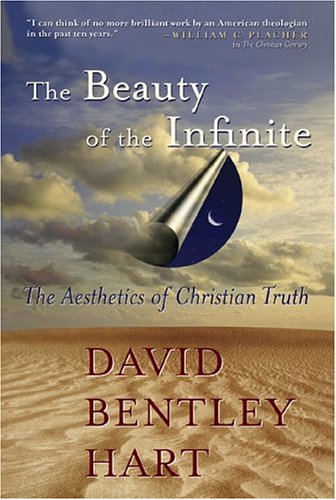
'Beauty of the Infinite' - Review

I finally completed Beauty of the Infinite. As I've mentioned in other posts, it was a difficult read for me in terms of my lack of familiarity with the works of many of the philosophers and theologians -- and the epochs of thought -- which Hart's argument builds upon. Though, I imagine it's also partially due to Hart's style, most notably his unrestrained erudition and massive vocabulary (spanning multiple languages), though this could be a false perception. In any case, the read became much easier as the book progressed, though I'm not sure if the latter half of the book is "objectively" less difficult, or whether I just became accustomed to the language and style of thought by that point.

This text doesn't seem to be intended for a lay audience at all, but it was an extremely rich, rewarding and perhaps revolutionary read for me. I never really thought that Christian tradition was lacking in theological richness, or in philosophical resources, but Beauty of the Infinite took my appreciation for that tradition to new heights. Much of that richness was undoubtedly already present in tradition, and I had just never encountered it. This is evident in the sections where Hart merely summarizes the thought of various theologians -- such as Gregory of Nyssa and Athanasius -- and those mere summaries of their thought gave me a greater appreciation for the Christian intellectual tradition.

On top of this mini-revelation are Hart's own theological and philosophical contributions which -- again from my vantage as a member of the laity -- are thorough, brilliant and enlightening. Hart's discourses on the analogia entis (the 'analogy of being'), Trinitarian dogmatics and the aesthetics of Christian truth particularly opened my mind just what it is that fundamentally differentiates Christian thought from other forms of thought, and the radical possibilities that open up as a result.

Specifically, the notion of the supremacy of surfaces and rhetoric (over and against 'essences' and 'dialectic') in Christian thought was something I had never fully grasped and which this text clarified for me. That the 'form' of Christ -- in all his particularity and beauty -- is fundamentally everything that Christianity has to offer. And how contrasting this style of thought to both the reductionist tendencies of modernity, as well as the nihilistic totalizing of postmodernity, reveals how Christian thought can accept that it is a kind of rhetoric, only one without peer.

This elevation of rhetoric -- the rhetoric of the Father as incarnate in Christ -- leads directly into the idea that Being is an expression of the Trinitarian God, as opposed to it being a 'univocal' expression. I had never fully considered the consequences of this. For if Creation is a truthful expression of its Creator then that Creation should express certain characteristics in its very fabric, and a 'univocal' expression of being would be very different from a Trinitarian expression. The Trinity possesses an internal dynamism, a life, an intrinsic grace, and when this conception of God is analogized to Creation, Creation should take on a certain form which also contains an irreducible dynamism.

So many discourses on being -- virtually all of them, even some Christian ones -- according to Hart, fail to completely grasp the implications of this "theological interruption" and what it consequently makes possible. In other words, Christian thought can, in many ways, consider itself immune to the critiques of modernity and postmodernity, once the critiques are properly understood. Not that it can evade engaging those critiques, but that it can answer them in a way that other forms of thought can not. Once the project of modernity -- to dissemble and distill reality into sets of self-evident truths, by way of "disinterested rationality" -- failed, Christian thought knew that this was inevitable because Truth is contained in the surface. And that surface is a a reflection of the Trinitarian God who similarly can not be reduced to principles or 'truths' that are more essential than (and therefore less than) the totality of Himself, as expressed in the form, the surface, the particularities of Christ.

This is a very inadequate summary of some aspects of Hart's arguments, but hopefully you get the general idea. This understanding of Christian truth was a revelation for me as the implications of this understanding have actually proved to be quite extensive. For anyone with any theological or philosophical training, Beauty of the Infinite is essential reading. For any lay person with a fairly intense intellectual curiosity and dogged persistence, the text can prove extremely rich and rewarding as well.

Tuesday, May 31, 2011

David B. Hart Wins Michael Ramsay Prize for 'Atheist Delusions'

The Archbishop of Canterbury, Rowan Williams, awarded the Michael Ramsay Prize (which is given for excellence in theological writing) to the inimitable David Bentley Hart for his book Atheist Delusions over the Memorial Day weekend. Atheist Delusions really is a phenomenal book (you can find my review of it here) and I'm glad it's getting deserved recognition.
In the book, Hart outlines how Christianity transformed the ancient world in ways we may have forgotten: bringing liberation from fatalism, conferring great dignity on human beings, subverting the cruelest aspects of pagan society, and elevating charity above all virtues. He then argues that what we term the "Age of Reason" was in fact the beginning of the eclipse of reason's authority as a cultural value. Hart closes the book in the present, delineating the ominous consequences of the decline of Christendom in a culture that is built upon its moral and spiritual values.

That's a very good synopsis of the book, and probably more helpful than anything in my review. In any case, I definitely echo the high recommendation of the estimable Archbishop.

Wednesday, April 13, 2011

David B. Hart on Barth and Being

I'm re-reading David B. Hart's Beauty of the Infinite, which I never quite made it through on my first go around. It contains a heavy dosage of philosophical and theological terminology and concepts, as well as obscure (to me) Greek, Latin, German and perhaps Russian terms which Hart doesn't bother translating for the lay person (though the usage often implies the meaning). All of which contributes to making it a difficult -- though often rich and rewarding -- read.

This book -- being Hart's proper, academic, theological magnum opus -- doesn't contain the typical tone of most of his more informal essays, which are usually satirical, acerbic, humorous and sometimes venomous. Occasionally, though, that more familiar Hart shines through.

In this excerpt he has just concluded an argument in defense of the analogia entis, or "analogy of being", as given meaning by Erich Przywara in the last century, which Barth in turn rejected and proclaimed that rejection essential to Protestantism.

Rejection of the analogy of being, properly understood, is a denial that creation is an act of grace that really expresses God's love, rather than a moment of alienation or dialectical negation; it is a rejection, that is, of Acts 17:28, and ultimately of Genesis 1:1 (and everything that follows from it). If rejection of the analogia entis were in some sense the very core of Protestant theology, as Barth believed, one would still be obliged to observe that it is also the invention of antichrist, and so would have to be accounted the most compelling reason for not becoming a Protestant.
Now there's the Professor Hart I know and love!

Friday, December 11, 2009

Surprised by Hope review/response (long)

I'm a little late on this. I just got around to reading Surprised by Hope by N.T. Wright, which some people recommended to me a few years ago. I thought it was a good book, with some very good observations on our apparent misconceptions (as both Christians and non-believers) about death, resurrection, and the afterlife. I agree with Wright's interpretation of bodily resurrection, and the hope of a new Earth and a new heaven. I take no issue with the content presented in the book, or the case presented for this interpretation of resurrection and the afterlife. Wright makes an extremely strong case for his perspective, and I believe this perspective corresponds most closely with the truth. Although the bulk of this article will be negative my overall response to the vast majority of the book was positive. I just don't have a lot to add to the stuff I agreed with other than saying that I do in fact agree.

All that being said, I do take issue with one of the central themes of the book. Specifically the issue of 'Does this matter?', and/or 'Is this significant, and if so, how significant?' Wright explicitly answers these two questions in part 3 of the book with a definitive 'Yes', and 'Yes, very', respectively. But I'm not convinced that it is AS significant as Wright claims that it is. It is significant in that it reveals a truth, and that's important enough in itself to justify writing the book and clarifying the issue for people who are obviously confused or uneducated on the subject. However, Wright claims that the significance extends beyond simply knowing what is true. He claims that understanding these truths will, or should, drastically transform how we live our Christian lives. Which I don't necessarily buy, though I understand and appreciate the case that he makes.

To illustrate what I'm getting at, let us take two Christians. Both of these Christians are crystal clear about what the Bible says about who Jesus is, about what his commands are, about how we as Christians are to live and treat each other, about the fact that Jesus died in our place and rose for our sins, conquering death etc. Also, both are at a similar place in their walk with Christ. That is, the 'strength' of their faith at this point in life is similar. The only place where these two Christians differ is that one (we'll call him #1) understands the afterlife correctly, the promise of bodily resurrection, Christ literally defeating death in a physical sense, a new heaven and new Earth joined together etc. while the other (#2) holds some common Platonic misconceptions about the afterlife, such as that of a disembodied soul leaving the body at death, ascending to heaven, leaving behind this doomed Earth forever etc.

Given this, what should we expect to see in the way of 'fruits' from these two Christians? It's my contention that their fruits, the degree to which they live a Christian life, should be roughly exactly the same, with neither bearing any more significant fruit than the other on average. But Wright argues (implicitly) that the latter Christian will most often bear significantly less fruit. That holding the beliefs that the 2nd Christian does will, in most cases, result in the Christian not caring enough about this life, not trying to change this world for the better, and just patiently awaiting the next, completely separate, disconnected and better life. Despite the fact that Jesus directly commands his followers to be concerned with this present world, and clearly lays out the ways to go about doing that. Regardless of the Christian's depth of understanding about the way in which afterlife and resurrection function.

If Christian #2, despite not correctly understanding the promise of bodily resurrection, understands and puts into practice Christ's commands, and follows his example, then his lack of understanding on that issue shouldn't affect his actions. Jesus said to help and care for the poor, so Christian #2 tries to do it as best as he can, end of story. Jesus said to follow him, to spread the good news of him and the salvation that he offers, and to love others, so that's what Christian #2 tries to do. Christian #1 does the same. If both Christians understand the example of Christ, and His words, to the same degree (and they find themselves at a similar node in life, with similar backgrounds, life experiences, etc.) then their actions should be approximately identical. We wouldn't expect to see any more from #1 than we do from #2.

Why then is it of utmost importance that a Christian fully comprehend these truths about the afterlife and resurrection (other than truth for truth's own sake)? If a Christian can live a dedicated, full Christian life under the misapprehensions of a disembodied soul ascending to heaven (which they can, and probably tens-to-hundreds of thousands do), then why is it so crucial? The elevation of the issue to such a level seems like a kind of intellectual elitism. The idea that only those of us privy to specific scholarly interpretations of the Bible can lead a fully realized Christian life. Christ is Lord of all, including the largely dull-witted masses incapable of parsing this issue effectively for themselves. Christ is even Lord of illiterates, for that matter. Which is not to say that rigorous study of the Bible shouldn't be done, of course it should be. But if it requires a working knowledge of multiple languages, historical cultural traditions, cultural differences, rigorous cross referencing of scripture given knowledge of the original language and what various phrases/words meant in different contexts, etc. to divine a particular truth then I can't very well believe God would intentionally make an essential truth relatively esoteric. And when I say 'essential' I mean that it's essential to understand the truth in order to live a full, Christian life. While the truth of the resurrection itself is certainly essential, I don't think it's essential to understand the exact machinations of that truth in order to lead a Christian life.

Let's be clear, Christian #2 still believes in the resurrection, still believes Christ died and rose (literally, bodily) for our sins, still believes that it is only through his work on the cross that we are saved from death and reconciled with God, still believes in and understands the importance of helping the poor and downtrodden, still believes that what he does or doesn't do in this world will have eternal consequences for himself and those around him (thus that this world is very important, and not wholly distinct and separate from heaven) etc. etc. Even if he is not fully cognizant of the machinations of hope, so to speak, even if he is mistaken as to the metaphysics of body-soul duality, even if he doesn't realize that Jesus 'conquering the grave' is not only Christ's literal defeating of death, but also a defeating of literal death for humanity etc. Even if he doesn't understand these things he can still lead a fully realized Christian life and do so just as easily as someone who does understand them.

A second, though not entirely separate, bone I have to pick also occurs in the third part of the book and also has to do with the implications of fully understanding these issues. Wright takes aim at Christian conservatism primarily in the US, and declares that a proper view of the resurrection and the Christian hope necessarily leads to the conclusion that global debt remission is the greatest moral crisis in the world today. Which I find to be a non-sequitur, though, to be fair, he states that he doesn't have space in this book to make that argument fully.

He goes on to straw man Christian conservatives by stating that they are happy about things such as acid rain, pollution and ecological damage. Or at least that they are not worried about them because of the temporary nature of this world. As well as stating that they believe that God must be happy about these things as well.

First of all, the Christian is commissioned to be a good steward of the Earth and all that is in within it even if they hold the false belief that the Earth is temporary and soon to perish. So whether or not they understand the reason why they should be a good steward, if they aren't being good stewards then they simply are not obeying God's commands. So I don't buy the argument that "If only they understood the 'WHY' then they would obey". No, they disobey because they are sinful, fallen humans, and they would disobey whether they understood the 'why' or not. You can be obedient without understanding and you can understand without being obedient. Comprehension is not a prerequisite for obedience.

Secondly it simply is not true that Western Christian conservatives like acid rain, or are ambivalent about pollution in the first place. Our perspective on the issue (if I can be so bold as to speak for us) is that it's an unfortunate byproduct of human progress, innovation, and increased standards of living for all people. And that God has created the Earth in specific preparation for us, fully capable of handling our pollution. Which is not to say that we shouldn't be good stewards and attempt to reduce our polluting activities as much as possible, clearly we are commanded to do just that. Only not at the expense of technological advancements that are, all factors accounted for, good for humans. Even if we could eliminate every trace of pollution from the planet along with every technology that created it, and therefore revert the human condition that has been dramatically improved through such technologies, we emphatically SHOULD NOT do it. It would be an act of supreme wickedness and an infliction of massive death and disease upon the human race if we were to do that. This is the argument that Christian conservatives make regarding pollution, yet Wright acts as though he's never heard the argument or at least hasn't understood it as he interprets the argument to be pro-pollution, or anti-responsibility-for-the-environment when it simply is neither.

Wright also states that, in light of the truth of bodily resurrection and all that goes along with it, somehow the economic policies of the right are also misguided in some way, though, again, this is more or less asserted and not at all supported by any argumentation that he provides. As far as I could see.

I am undoubtedly giving off the impression that I dislike the book or that I disagree with it's fundamental arguments, but I don't really. I very much appreciate the scholarship of Wright and the manner in which he organizes his arguments. I think the truths he reveals have the potential to be powerful apologetic tools as well. Many secularists, or just seeking non-believers, have complaints about Christianity that simply dissolve in the light of many of these truths, so that was also an invigorating aspect of the book, I found. I don't want to downplay the importance of what the book gets right, which, when it comes to the substance, is pretty much everything. I only take issue with some of the supposed implications of the various truths.