Showing posts with label philosophy. Show all posts

Wednesday, September 25, 2013

Being, Consciousness, Bliss [Review]

Astonishingly, given the somewhat deceptive (or perhaps inept) marketing of the book, this was David Bentley Hart's best book to date, which is saying something monumental. What neither the title, nor the jacket cover, nor even the blurb reviews reveal is that the book is primarily a relentless, blistering attack on the superstitions and credulous fideisms of materialism. Over and against this decrepit and impoverished philosophy of reality, and in response to its inept attempts to demystify the world, Hart turns to the common deposit of theistic metaphysical tradition for the arresting and compelling antidote. 

In the mystery of being, in the mystery of consciousness, and in the manner that they blissfully coinhere as a surfeit of physical reality, the Supernatural, the Absolute, the Good, Beauty -- in a word -- God is immediately present to us in every moment. Yet we dull and numb ourselves to this reality in innumerable ways, but especially through the barbarisms of the 'mechanical philosophy' that we have inherited from 'the Enlightenment'. 

As for the attempts of naturalism to sweep away such an obvious reality, Hart is insistent all such attempts are pitifully incoherent and suffer massive -- almost certainly insuperable -- explanatory deficiencies. While the traditional metaphysical arguments for God -- arguing from contingency to a necessary and absolute ground of being, for example -- are comparatively sublime with scarcely any of the objections lodged against them being worth serious consideration.

According to Hart, most materialistic attempts to deal with the question of being either try to dismiss the central question -- namely "why is there something rather than nothing?" -- as a fallacy of grammar or as ultimately unintelligible (it clearly is not), or to posit that the sum total of contingent, physical reality might somehow (magically and irrationally) add up to the source of its own being, and not itself be contingent. And that's when they're not being really sloppy, confusing cosmology for metaphysics and making simplistic category errors such as mistaking a quantum vaccuum for 'nothing.'

Similarly impotent are the physicalist accounts of consciousness, which Hart sees as an undeniably immaterial datum, and the most primordial one of them all, present to each of us in every moment and upon which all other realities that we perceive are dependent. Hart claims there is an infinite qualitative abyss between the neurochemical events which consciousness is dependent upon and consciousness as experienced, such that no number of purely quantitative mechanical steps could ever give rise to this peculiar and fortuitous subjective interiority, which each of us owes all our knowledge, experience, and awareness to. Hart writes:
Most attempts to provide an answer [to the question of consciousness] without straying beyond the boundaries of materialist orthodoxy are ultimately little more than vague appeals to the power of cumulative complexity: somehow, the argument goes, a sufficient number of neurological systems and subsystems operating in connection with one another will at some point naturally produce unified, self-reflective, and intentional consciousness, or at least (as strange as this may sound) the illusion of such consciousness. This is probably just another version of the pleonastic fallacy, another hopeless attempt to overcome a qualitative difference by way of an indeterminably large number of gradual quantitative steps. Even if it is not, it remains a supposition almost cruelly resistant to scientific investigation or demonstration, simply because consciousness as an actual phenomenon is entirely confined to the experience of a particular mind, a particular subject.
With this being the case, materialist accounts of consciousness reek of magical thinking. Even if we grant that one day neurobiology will exhaustively map every aspect of the brain, science will have not come a step closer to puncturing through the veil and entering into the content and interiority of the purely subjective conscious mind. One can only deny that such an immaterial, or supernatural, reality exists -- if one can at all -- by sacrificing reason itself on the alter of materialism in a self-immolating act. A high price to pay, indeed, if one is to prize 'reason' and 'empiricism' above all else, as so many scientistic materialists putatively do. 

Just as impossible to account for on materialistic terms is the innate human longing for the Good and the concomitant abhorrence of evil, which materialists must deny as being in any sense 'real' in favor of them being illusions in a deterministic universe (though few of them seem willing to fully come to terms with this logical inevitability). If you can't but do what you are bound by the laws of physics to do -- as you are no more than matter in motion -- no materialistic morality can ever amount to anything more than nonsense. As Hart puts it:
A naturalist morality is a manifest absurdity, something rather on the order of a square circle, and it requires almost heroic contortions of logic to make the notion seem credible. Fortunately, the human will to believe is indefatigable.
Attempts to ground morality in evolutionary incentives (once materialism has cleared the hurdle of being and consciousness, which it necessarily can not do) are ultimately tragically resistant to empirical verification, and must always remain just-so fables. This doesn't mean that it's completely false that certain evolutionarily advantageous 'moral' traits are preserved and passed along via natural selection acting on genetic material, but this hardly is an account of the actual nature of human morality as it exists. From a materialist perspective what would be called 'moral' can't be other than that which is evolutionarily advantageous, and our genetic so-called 'self-interest' (wherever it comes from, and whatever it is exactly), is tied to the interest of, for example, our tribe. Hence a degree of selflessness and cooperation (at least within the tribe, though usually not between tribes) is more likely to ensure the passing on of our genetic material. This hardly explains the origin of the moral impulse, however, rather only its transmission within the species. And even then, only to an incomplete degree, when we consider the many ways that the moral impulse far exceeds, and often contradicts, the dictates of evolutionary incentives. The evolutionary explanations of this phenomenon are quite clearly ludicrous attempts to force the data into a conceptual scheme which has no room for it. 

Central to Hart's argument is the claim that most of the contemporary debates surrounding God do not have as their subject the God of traditional theistic metaphysics, but rather some particularly potent cosmic demiurge, or watchmaker god, or an especially large and benevolent gentleman who is perhaps the first of a long series of causes, but not Being as such which gratuitously donates being to beings. Not the God who is utterly transcendent and fully imminent, filling all things, yet beyond all things. Not the fullness of actuality, in whom we live, and move, and have our being. etc. Once such a confusion is eliminated, and the content of the concept of God is understood as it has widely and traditionally understood by the venerable contemplative theistic traditions, most of the contemporary debates melt away into utter irrelevance.

Hart covers a great deal more than I've hinted at here: teleology and intentionality in consciousness as necessary elements of reality, and without which we can't begin to reason; the self-defeating and demonstrably false assertion of scientific empiricism having an exclusive claim to genuine knowledge; qualia as a datum inexplicable by naturalism; the materialist failure to dispel with free will; the manner in which being, consciousness, and bliss interrelate and are not only metaphysical explanations of God, but also phenomenological explanations of the human encounter with God; the absolute poverty of materialistic aesthetic accounts; mystical experience visa vis contemplative prayer and asceticism as the only 'empirical' means for investigating 'the God claim'. Just to name a few. 

Rising above the nature of the current debate on such issues -- both sides of which usually share covertly atheistic presuppositions -- Hart's lucid argumentation, acerbic wit, and stellar prose masterfully combine to produce one of the most stunning, potent, holistic, and engaging arguments for belief in God and against materialism that I've ever read.

-------------------------------------------

P.S. In one of the blurb reviews advertising the book, Hart was said to have been advocating an 'ecumenical theism'. Happily, that's not exactly accurate. To an Orthodox -- or any religious particularist, really, but especially to Orthodox -- such language can sound like syncrenistic sloppiness, if not heresy. Hart makes clear in the introduction that in attempting to define 'God' as precisely as possible, and in accordance with the overlapping metaphysical wisdom of all the venerable theistic traditions, he isn't advocating a milquetoast relativism or against particularism, and certainly not denying the truth of the full revelation of God in Christ. Rather, he is only attempting to provide clarity to an essentially philosophical debate that is desperately in need of it. He is quick to note that, such philosophical knowledge about God, is not the same as union with God or knowledge of God, in accordance with Orthodox teaching.

Monday, September 23, 2013

Žižek, Tony Jones, and 'Christian Atheism'

A little over a week ago, Tony Jones hosted a piece that was meant to service as an introduction to Slavoj Žižek, particularly his 'Christian' or 'theological' thought. I took issue with the piece, primarily with the notion that it's acceptable for Christians to get their theology from atheists, or for atheists to do Christian theology in any legitimate sense. Such an idea is, of course, absurd. And this seemed to me like a fairly elementary and obvious point to make, eminently supported by scripture and orthodox Christian tradition. But I also know that one of the dogmas of this particular brand of progressive, postmodern, heretical Christianity is a kind of infinite openness to ideas and 'dialogue', regardless of the provenance of said ideas (blatantly ignoring scriptural warnings against such absolute openness i.e. Romans 12:2, 2 Cor. 6:14-18, Gal 5:1, 1 Tim. 4, 2 Tim. 2:16-17, 2 Tim 4:3-4, etc.). Wanting to disabuse anyone who might listen of such a dangerous openness in theology -- especially with regard to atheists, worldly speculators and conjecturalists -- I happily obliged when Tony offered to host a response by me.

To Tony's immense credit, and contrary to the actions of one of his brother's in arms, he published my response which he disagreed with, and in which I even take a pot-shot at him. This demonstrates a true openness to dialogue and opinions from all quarters, even the traditionalist-conservative quarter, and so consistency with his principles (although it also reveals a bit of a masochistic streak).

There was a fairly large dust-up in response to my piece (on Twitter, primarily), as many of Tony's readers -- quite understandably, given their vantage point -- took issue with the piece and with Tony's decision to run it. Tony replied here in defense of running the piece, and I agree with his defense.

However, while defending his running of the piece he also briefly noted why he disagrees with it. He writes:
The bottom line is that Nathan thinks that, while interesting, Christians should never look to Žižek for theological insight. In fact, he thinks that Christians should never take any theological insight from an atheist.
Well, I think that’s hogwash. (Nathan defends this as a teaching of the Orthodox Church, but I have not been able to substantiate that.) Theological insight comes from all sorts of places, atheists included. Indeed, if we’re reliant solely upon the church for theological truth, then two things are true: 1) God is bound exclusively to one human institution (a laughable idea), and 2) we’re pretty much screwed (because the church is so clearly fallible).
Before defending the idea that Christians ought not turn to atheists for theological insight, (it feels a bit odd typing that) let me first clarify a few things that I'm not saying. I'm not saying that God doesn't reveal himself in a general way through creation. I'm also not saying that God doesn't act in the lives of unbelievers at all. I'm also not saying that non-Christian philosophy is completely useless. None of this, however, means that atheists are capable of anything (truly) good apart from regeneration in the waters of baptism and a subsequent life in Christ, much less are they able to add or somehow contribute to the full revelation of God in Christ through their blasphemous speculations which deny Christ.

To the extent that worldly philosophy has value, it's that, in its venerable formulations, one can see what St. Justin Martyr -- writing in the 2nd century as a convert from Greek paganism -- referred to as the spermatikos logos. This is the seed of divinity in each human person which can be dimly apprehended through Greek philosophy, for example, which in turn acts as a preparation for the full revelation of God in Christ and his Church.

But this is only the case where Greek philosophy dimly apprehended the truth of divinity, not where it raged directly against it in utter folly (Psalm 14:1), or where it continued to do so even when confronted with Christ and his Church. And this is the crucial distinction. In the latter case, the Church (and the Bible) unequivocally rejects the notion that there can be any parity or fellowship between the Church which confesses Christ come in the flesh and risen from the dead, and those who deny it. Hear 1 John 4:3 :
And every spirit that confesseth not that Jesus Christ is come in the flesh is not of God: and this is that spirit of antichrist.
Žižek confesseth not. Game over.

Of course, one could multiply at will references to the New Testament's stark and undeniable dichotomy between the Kingdom of God and the kingdom of the 'god' of this world (2 Cor. 4:4) i.e. Satan. See: James 4:4, John 16:33, 1 John 2:17, Rev. 3:15-17, etc. And if 'the world' (in this sense) does not include the spirit of antichrist which denies Christ is God in the flesh, then there is no such thing as 'the world' in this sense, and the Bible is speaking nonsense. This seems a high price to pay in order to defend an illicit and wicked desire to marry truth with error, darkness with light. Speaking of which, we could also turn to the most clear and unequivocal scriptural rebuke of Jones and co.'s modus operandi in 2 Cor. 6:14-18.

As for whether my position is that of the Orthodox Church, I would want to tread carefully in claiming to speak for the Church. Though I would say that, in the Church's vindication of the teaching of St. Gregory Palamas in the 14th century over the heresy of Barlaam, the purity of heart obtained through the healing graces of the Church was defended as essential for genuine theology. The impotence of philosophy to lead to true illumination was also confirmed by the Church, in the course of this controversy. Which would all be relevant here, both as a rebuke of Žižek and his 'Christian' defenders.

One could go on to note that the actual content of Žižek's 'theological' speculations (if he truly held to them), and not just the method used to arrive at them, are formally rejected heresies. One of the earliest and most significant heresies in Church history, propagated in the 4th century by the bishop Arius, was that Christ was divine, yes, but a created and subsidiary divinity, and not consubstantial with the Father. At Nicaea, his view was anathematized by the Church as incompatible with the apostolic deposit of faith, at which point it became impossible for Arian speculation to count as true Christian theology. If Arius confessed Christ's divinity (albeit as a created demigod), and was and is anathema, as are any who follow him, how much more of those who deny that God even exists?

Granted, with this last move I've made an argument that appeals to a particular biblical, apostolic, orthodox ecclesiology. And therefore I might be talking past those who hold to the anti-ecclesiology of protestantism, especially in its progressive-postmodern-evangelical variant. C'est la vie. One can only hope they turn from this error as swiftly as they ought to turn and flee from the error of mixing God's truth with a lie.

Monday, February 20, 2012

Beauty, Postmodernism, and Christianity

While the ground sought by modernity proved to be elusive, thereby yielding the postmodern critique of modernity, the Christian claim to reality welcomes the postmodern critique. Not so that our particular metanarrative can sit comfortably alongside other metanarratives and live in harmony with them, but because our metanarrative is comparatively so robust, so compelling, so sensible and necessary in the light of all relevant experiential and evidential data -- in other words so beautiful. Strict relativism is an illegitimate position to deduce from the premises of postmodernity; the fact that there exist a plethora of metanarratives -- none of which can be its own objectively justified grounding -- does not mean that all metanarratives are of equal value or quality, or that one can't be present which is the metanarrative that supersedes and subsumes all other metanarratives. Christian truth, properly understood, always has been a rhetoric which presents itself aesthetically, first and foremost. The truth of Christianity can't be divorced from its beauty.

None of this is a concession that the object of Christian worship, the Triune God of the Bible, is anything (or really Anyone) less than absolute Truth, only that He can't be conclusively shown to be such in the interaction between finite minds (some currently imbued with the Holy Spirit and some not). Instead it's to say that the vibrancy and beauty of the Christian metanarrative, and the relative impoverishment of all others, is a signpost that points to the probable Truth of the Christian claim. Or, more precisely, that its truth and beauty have a dialectic relationship which testifies to its supremacy over all other metanarratives. Claims that some other rhetoric has comparable or greater force I dismiss, not out of hand, but out of the knowledge obtained in my investigation of the matter. If there really is no Capital-T Truth, then beauty will ultimately only be in the eye of the beholder, of course, and then those alternate claims are just as valid as mine; but if Truth is out there, then that Truth will be Beauty itself, and it becomes possible for one rhetoric to rise above and absorb all others into itself. The postmodern turn in philosophy doesn't answer the question of whether Truth is out there, but only says that there is no dispassionate, objective position we can occupy to access this knowledge and demonstrate that we have done so. The latter postulate is what seems to be forgotten often.

Incidentally, even some highly influential non-theist thinkers such as Hegel -- and some contemporary Hegelians, such as Slavoj Zizek -- seem to accept the supremacy of Christian rhetoric. While they don't make the move that I do here -- claiming that the nonpareil beauty of the Christian rhetoric is an overwhelming testament to its Truth -- they do affirm its beauty and its potency as a means for understanding the world.

As I've hinted at, modernity need not remain entirely silent on this issue; the popularized version of the postmodern triumph in epistemology and philosophy is a catastrophist model, meaning that it envisions postmodernity counteracting modernity and overturning it; in reality the postmodern project was really inaugurated within modernity all along, and postmodernity is really just its consummation. With this in mind, the internal coherence of the Christian story can still be examined by traditionally modern methods, and how well (or poorly) it fairs under such scrutiny will testify for (or against) its Beauty, which in turn will comment on its claim to Truth. If it patently fails, for example, this would obviously severely cripple its aesthetic appeal; conversely, if it stands up as well as can be expected, this fact either acts as an element of the rhetoric of the Christian story itself, or at least something that acts as an adjacent support structure for it.

With this position laid out, the only task that remains is actually presenting the rhetoric in question. Though it's of course too large a task for this trifle of a post, or for any individual, I can at least point you to the location of the current development of that rhetoric, which is Christ's church on Earth, inhabited and empowered by the Holy Spirit. The church, the Body of Christ, is a furthering of the rhetoric which begins with the loving God of creation making Man in His image for His pleasure, and then reconciling the fallen world to Himself through Christ, the second person of the Trinity. This is, of course, a terribly inadequate thumbnail sketch of the totality of the staggering beauty of Christian rhetoric, which can only be fully appreciated by partaking in that rhetoric, but can also be seen (to some degree) from the outside, if approached humbly, thoughtfully, and prayerfully.

My (self-imposed) task here wasn't to demonstrate the beauty of the rhetoric itself -- though I do earnestly implore anyone reading to investigate the matter for themselves -- but only to make the case that, within a postmodern framework, Beauty becomes a primary concern which can present a more powerful and potent case for one metanarrative's supremacy over others, which in turn can become an argument for its Truth.

-------------------------

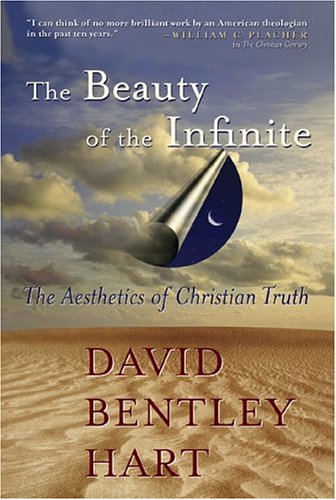
This post was inspired entirely by David Bentley Hart's Beauty of the Infinite. I make no claims to originality, but my thoughts on this subject were flitting through my head and asking to be transcribed in my own words.

Thursday, June 9, 2011

'Beauty of the Infinite' - Review

I finally completed Beauty of the Infinite. As I've mentioned in other posts, it was a difficult read for me in terms of my lack of familiarity with the works of many of the philosophers and theologians -- and the epochs of thought -- which Hart's argument builds upon. Though, I imagine it's also partially due to Hart's style, most notably his unrestrained erudition and massive vocabulary (spanning multiple languages), though this could be a false perception. In any case, the read became much easier as the book progressed, though I'm not sure if the latter half of the book is "objectively" less difficult, or whether I just became accustomed to the language and style of thought by that point.

This text doesn't seem to be intended for a lay audience at all, but it was an extremely rich, rewarding and perhaps revolutionary read for me. I never really thought that Christian tradition was lacking in theological richness, or in philosophical resources, but Beauty of the Infinite took my appreciation for that tradition to new heights. Much of that richness was undoubtedly already present in tradition, and I had just never encountered it. This is evident in the sections where Hart merely summarizes the thought of various theologians -- such as Gregory of Nyssa and Athanasius -- and those mere summaries of their thought gave me a greater appreciation for the Christian intellectual tradition.

On top of this mini-revelation are Hart's own theological and philosophical contributions which -- again from my vantage as a member of the laity -- are thorough, brilliant and enlightening. Hart's discourses on the analogia entis (the 'analogy of being'), Trinitarian dogmatics and the aesthetics of Christian truth particularly opened my mind just what it is that fundamentally differentiates Christian thought from other forms of thought, and the radical possibilities that open up as a result.

Specifically, the notion of the supremacy of surfaces and rhetoric (over and against 'essences' and 'dialectic') in Christian thought was something I had never fully grasped and which this text clarified for me. That the 'form' of Christ -- in all his particularity and beauty -- is fundamentally everything that Christianity has to offer. And how contrasting this style of thought to both the reductionist tendencies of modernity, as well as the nihilistic totalizing of postmodernity, reveals how Christian thought can accept that it is a kind of rhetoric, only one without peer.

This elevation of rhetoric -- the rhetoric of the Father as incarnate in Christ -- leads directly into the idea that Being is an expression of the Trinitarian God, as opposed to it being a 'univocal' expression. I had never fully considered the consequences of this. For if Creation is a truthful expression of its Creator then that Creation should express certain characteristics in its very fabric, and a 'univocal' expression of being would be very different from a Trinitarian expression. The Trinity possesses an internal dynamism, a life, an intrinsic grace, and when this conception of God is analogized to Creation, Creation should take on a certain form which also contains an irreducible dynamism.

So many discourses on being -- virtually all of them, even some Christian ones -- according to Hart, fail to completely grasp the implications of this "theological interruption" and what it consequently makes possible. In other words, Christian thought can, in many ways, consider itself immune to the critiques of modernity and postmodernity, once the critiques are properly understood. Not that it can evade engaging those critiques, but that it can answer them in a way that other forms of thought can not. Once the project of modernity -- to dissemble and distill reality into sets of self-evident truths, by way of "disinterested rationality" -- failed, Christian thought knew that this was inevitable because Truth is contained in the surface. And that surface is a a reflection of the Trinitarian God who similarly can not be reduced to principles or 'truths' that are more essential than (and therefore less than) the totality of Himself, as expressed in the form, the surface, the particularities of Christ.

This is a very inadequate summary of some aspects of Hart's arguments, but hopefully you get the general idea. This understanding of Christian truth was a revelation for me as the implications of this understanding have actually proved to be quite extensive. For anyone with any theological or philosophical training, Beauty of the Infinite is essential reading. For any lay person with a fairly intense intellectual curiosity and dogged persistence, the text can prove extremely rich and rewarding as well.

Wednesday, April 13, 2011

David B. Hart on Barth and Being

I'm re-reading David B. Hart's Beauty of the Infinite, which I never quite made it through on my first go around. It contains a heavy dosage of philosophical and theological terminology and concepts, as well as obscure (to me) Greek, Latin, German and perhaps Russian terms which Hart doesn't bother translating for the lay person (though the usage often implies the meaning). All of which contributes to making it a difficult -- though often rich and rewarding -- read.

This book -- being Hart's proper, academic, theological magnum opus -- doesn't contain the typical tone of most of his more informal essays, which are usually satirical, acerbic, humorous and sometimes venomous. Occasionally, though, that more familiar Hart shines through.

In this excerpt he has just concluded an argument in defense of the analogia entis, or "analogy of being", as given meaning by Erich Przywara in the last century, which Barth in turn rejected and proclaimed that rejection essential to Protestantism.

Rejection of the analogy of being, properly understood, is a denial that creation is an act of grace that really expresses God's love, rather than a moment of alienation or dialectical negation; it is a rejection, that is, of Acts 17:28, and ultimately of Genesis 1:1 (and everything that follows from it). If rejection of the analogia entis were in some sense the very core of Protestant theology, as Barth believed, one would still be obliged to observe that it is also the invention of antichrist, and so would have to be accounted the most compelling reason for not becoming a Protestant.
Now there's the Professor Hart I know and love!

Wednesday, March 3, 2010

'Why' Questions Are Inherently Questions About God

When you ask 'why', you are asking 'for what purpose?', 'for what reason?' or 'to what end?' Inherent in any question of 'why' is the assumption that there is a rational intelligence behind whatever system, or set of facts the question is being asked about. For example, if you ask 'why' the sun rises every day, a scientist might (errantly) explain the various physical mechanisms and facts that we know lead to the sun rising. The scientist is really answering the question of 'how', and not 'why'. When you ask why the sun rises, you're asking for what purpose. Even asking the question implies a recognition of a will, and of an intelligence, responsible for making the sun rise. For it makes no sense to ask 'for what purpose' or 'to what end', or 'why' a random, chaotic, un-planned event happened.

If you are a naturalist, that is you believe the natural world is all that exists, then you can only rightly ask 'why' questions about human decisions. Why this person did this, or why did that guy do that. You can't coherently ask 'why' questions about any natural phenomena that occur independent of human will, for the question becomes nonsense. 'Why is the sky blue?', 'Why do earthquakes occur?', 'Why does the mockingbird sing?' Forget about being answered, none of these questions can even be asked by a naturalist. They must either be recognized as incoherent, or the 'why's must be replaced with 'how's.

Therefore it's my contention that the very fact that 'Why' questions preoccupy so much of human inquiry, probably the vast majority of it, is evidence that God exists. If we are solely the product of natural phenomena, then what evolutionary paradigm could our mental preoccupation with the nonsensical question of 'why' possibly serve? As a matter of fact, in evolutionary terms, that very preoccupation would be a quite costly, and dangerous distraction from more pertinent questions such as 'when' 'where' and' how' to secure our next meal, for example.

But if we are the product of a will, and of an intelligence, made in that image, then it follows that we would want to understand the reason behind events occuring. And that the rational being that created us would endow us with rational faculties of our own, and a curiosity to understand not only the what, where, when and how, but also the why.