While the ground sought by modernity proved to be elusive, thereby yielding the postmodern critique of modernity, the Christian claim to reality welcomes the postmodern critique. Not so that our particular metanarrative can sit comfortably alongside other metanarratives and live in harmony with them, but because our metanarrative is comparatively so robust, so compelling, so sensible and necessary in the light of all relevant experiential and evidential data -- in other words so beautiful. Strict relativism is an illegitimate position to deduce from the premises of postmodernity; the fact that there exist a plethora of metanarratives -- none of which can be its own objectively justified grounding -- does not mean that all metanarratives are of equal value or quality, or that one can't be present which is the metanarrative that supersedes and subsumes all other metanarratives. Christian truth, properly understood, always has been a rhetoric which presents itself aesthetically, first and foremost. The truth of Christianity can't be divorced from its beauty.
None of this is a concession that the object of Christian worship, the Triune God of the Bible, is anything (or really Anyone) less than absolute Truth, only that He can't be conclusively shown to be such in the interaction between finite minds (some currently imbued with the Holy Spirit and some not). Instead it's to say that the vibrancy and beauty of the Christian metanarrative, and the relative impoverishment of all others, is a signpost that points to the probable Truth of the Christian claim. Or, more precisely, that its truth and beauty have a dialectic relationship which testifies to its supremacy over all other metanarratives. Claims that some other rhetoric has comparable or greater force I dismiss, not out of hand, but out of the knowledge obtained in my investigation of the matter. If there really is no Capital-T Truth, then beauty will ultimately only be in the eye of the beholder, of course, and then those alternate claims are just as valid as mine; but if Truth is out there, then that Truth will be Beauty itself, and it becomes possible for one rhetoric to rise above and absorb all others into itself. The postmodern turn in philosophy doesn't answer the question of whether Truth is out there, but only says that there is no dispassionate, objective position we can occupy to access this knowledge and demonstrate that we have done so. The latter postulate is what seems to be forgotten often.
Incidentally, even some highly influential non-theist thinkers such as Hegel -- and some contemporary Hegelians, such as Slavoj Zizek -- seem to accept the supremacy of Christian rhetoric. While they don't make the move that I do here -- claiming that the nonpareil beauty of the Christian rhetoric is an overwhelming testament to its Truth -- they do affirm its beauty and its potency as a means for understanding the world.
As I've hinted at, modernity need not remain entirely silent on this issue; the popularized version of the postmodern triumph in epistemology and philosophy is a catastrophist model, meaning that it envisions postmodernity counteracting modernity and overturning it; in reality the postmodern project was really inaugurated within modernity all along, and postmodernity is really just its consummation. With this in mind, the internal coherence of the Christian story can still be examined by traditionally modern methods, and how well (or poorly) it fairs under such scrutiny will testify for (or against) its Beauty, which in turn will comment on its claim to Truth. If it patently fails, for example, this would obviously severely cripple its aesthetic appeal; conversely, if it stands up as well as can be expected, this fact either acts as an element of the rhetoric of the Christian story itself, or at least something that acts as an adjacent support structure for it.
With this position laid out, the only task that remains is actually presenting the rhetoric in question. Though it's of course too large a task for this trifle of a post, or for any individual, I can at least point you to the location of the current development of that rhetoric, which is Christ's church on Earth, inhabited and empowered by the Holy Spirit. The church, the Body of Christ, is a furthering of the rhetoric which begins with the loving God of creation making Man in His image for His pleasure, and then reconciling the fallen world to Himself through Christ, the second person of the Trinity. This is, of course, a terribly inadequate thumbnail sketch of the totality of the staggering beauty of Christian rhetoric, which can only be fully appreciated by partaking in that rhetoric, but can also be seen (to some degree) from the outside, if approached humbly, thoughtfully, and prayerfully.
My (self-imposed) task here wasn't to demonstrate the beauty of the rhetoric itself -- though I do earnestly implore anyone reading to investigate the matter for themselves -- but only to make the case that, within a postmodern framework, Beauty becomes a primary concern which can present a more powerful and potent case for one metanarrative's supremacy over others, which in turn can become an argument for its Truth.
-------------------------
This post was inspired entirely by David Bentley Hart's Beauty of the Infinite. I make no claims to originality, but my thoughts on this subject were flitting through my head and asking to be transcribed in my own words.
Showing posts with label beauty. Show all posts
Showing posts with label beauty. Show all posts
Monday, February 20, 2012

Wednesday, April 13, 2011
David B. Hart on Barth and Being
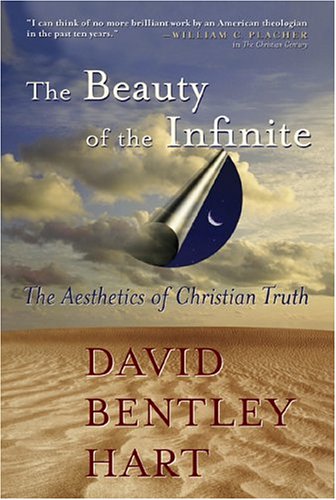 I'm re-reading David B. Hart's Beauty of the Infinite, which I never quite made it through on my first go around. It contains a heavy dosage of philosophical and theological terminology and concepts, as well as obscure (to me) Greek, Latin, German and perhaps Russian terms which Hart doesn't bother translating for the lay person (though the usage often implies the meaning). All of which contributes to making it a difficult -- though often rich and rewarding -- read.
This book -- being Hart's proper, academic, theological magnum opus -- doesn't contain the typical tone of most of his more informal essays, which are usually satirical, acerbic, humorous and sometimes venomous. Occasionally, though, that more familiar Hart shines through.
In this excerpt he has just concluded an argument in defense of the analogia entis, or "analogy of being", as given meaning by Erich Przywara in the last century, which Barth in turn rejected and proclaimed that rejection essential to Protestantism.
Rejection of the analogy of being, properly understood, is a denial that creation is an act of grace that really expresses God's love, rather than a moment of alienation or dialectical negation; it is a rejection, that is, of Acts 17:28, and ultimately of Genesis 1:1 (and everything that follows from it). If rejection of the analogia entis were in some sense the very core of Protestant theology, as Barth believed, one would still be obliged to observe that it is also the invention of antichrist, and so would have to be accounted the most compelling reason for not becoming a Protestant.Now there's the Professor Hart I know and love!
Subscribe to:
Posts (Atom)