
I'm going to put in a short, good word on behalf of the excellent book by Heiromonk Gabriel Bunge, The Rublev Trinity. In the book, Bunge traces the historical development of the iconographical tradition of Genesis 18, or the Hospitality of Abraham, beginning in the 4th century and culminating in the 14th century with the Russian monk Andrei Rublev's famous icon. Due to the iconoclasm of the 7th and 8th centuries, the extant icons from the first millennium are very limited in number, but they still provide a sense of the various contours of the tradition.
Broadly speaking, the tradition goes from angelological to christological to trinitarian. The visitors are originally portrayed as simply three angels who visit Abraham; as the tradition develops, the central angel begins to be distinguished as a type of Christ; and finally the tradition comes to full fruition by reading the episode as a typographical appearance of the Holy Trinity.
To refresh your memory, in Genesis 18 Abraham and Sarah are visited by three men, one of whom is called "Lord" by Abraham, and who Abraham and Sarah show hospitality by preparing a meal -- bread and a calf -- for. The Lord goes on to tell Sarah that she will bear a child in her old age, and then reveals to Abraham the coming fate of Sodom of Gomorrah.
Some of the earliest frescoes show the three visitors as angels and as essentially identical, or as slightly different but not in any manner distinguishing one as more significant than the other two.

By the 5th century, certain distinctly christological elements begin to arise. A mosaic from San Vitale, Ravenna (pictured above), placed in the sanctuary of the Church, reveals that the scene is being understood as an Old Testament type of the Eucharist. This is due both to the elements of the icon itself (the calf in the dish, as a type of Christ, the Lamb that was slain "from before the foundation of the world."), as well as its placement within the Church space: in the alter area (where the Holy Gifts are prepared) and adjacent to depictions of the sacrifices of Abel and Melchisdec. This is significant because, according to the Epistle to the Hebrews, "Christ is both simultaneously the sacrifice and the priest: prefigured in Abel (cf. Heb 12:24), Melchisdec (Heb passim), and Isaac (Heb 11.19)." In this icon, the three angels are portrayed as almost identical to each other, with no real distinguishing features.
As the iconographical tradition develops, it begins to single out one of the angels as distinctly representing Christ, while the other two are reduced to angelic companions. This is done by changing the color of the central angel's nimbus to red, then by including a cross within the nimbus and depicting him as much larger than the other two angels, and later by dressing him the way that Christ is usually depicted as dressing in iconography.
(Again, I'm outlining the iconographical tradition in extremely broad, inelegant strokes. For the full picture, please read this excellent text.)
A Trinitarian type of depiction begins to take shape long before Andrei Rublev's definitive icon is written, as many icons of the Hospitality of Abraham began to bear the title "The Holy Trinity", along with the depictions themselves becoming more trinitarian. But to save space I want to skip straight to Rublev's icon and discuss it some, with the guidance of Heiromonk Bunge.
A Trinitarian type of depiction begins to take shape long before Andrei Rublev's definitive icon is written, as many icons of the Hospitality of Abraham began to bear the title "The Holy Trinity", along with the depictions themselves becoming more trinitarian. But to save space I want to skip straight to Rublev's icon and discuss it some, with the guidance of Heiromonk Bunge.
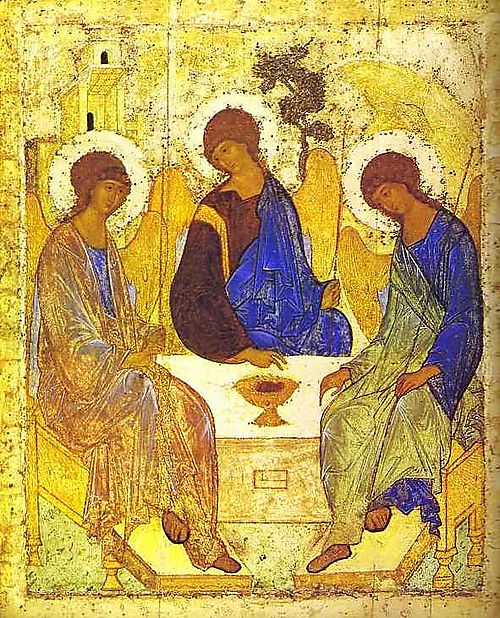
During the development of the tradition, Abraham and Sarah were depicted for a long time, but in Rublev's icon they are no longer there. The observer takes their place as he gazes upon a type of the mystery of the Holy Trinity, and is invited to become a partaker in the inter-Trinitarian life that opens up to him by way of the Eucharist. Because the icon is a festal icon for Pentecost, Bunge reads the icon as a pictorial representation of Christ's Farewell Discourse in John 14-20, which "is completely shot through with the mystery, now being revealed, of the Triune God."
In that discourse, Our Lord begins by telling his disciples that in His "Father's house are many rooms; if it were not so, would I have told you that I go to prepare a place for you?" Note the house in the background of the icon, which aligns with the figure on the left. This is one indication that the figure on the left is to be read as a type of the Father, which becomes more certain the more we contemplate the icon.
Rublev follows in the iconographical tradition that identifies the central angel as the Son. This is made clear by his dress, which is the same as that of Christ in most iconography. In addition to this, a vertical line through the center of the icon aligns the central figure with the calf in the chalice, as well as the tree in the background, which Bunge reads as an image of the Tree of Life and the Cross. Another visual cue is that the outlines of the bodies of the outer angels form a second chalice, within which the central angel sits, further deepening the Eucharistic theme.
One interesting thing that I learned from this book is that, in the process of recovering the icon from being painted over, one of the two fingers of the central angel was added on later. Originally, the only finger extended was that which now appears to be the middle finger, but is actually the index finger. This is significant because the gesture of the central figure is actually pointing at the chalice, and past it to the third figure, the angel on the right that represents the Holy Spirit.
The angel on the left inclines his head toward neither of the other two, while they both incline theirs in the same angle toward him. This is a visual depiction of the fact that, in concert with orthodox Trinitarianism, the Father is the fountainhead -- the monarchia -- of being, from whom the Son is eternally begotten and from whom the Spirit eternally proceeds.
Further, the figure on the left is clothed such that no arm is 'free', while the Christ-figure's right arm is uncovered, and the Holy Spirit's left arm is. This is another means for distinguishing the figures, and draws on the venerable, orthodox formula of St. Irenaeus of Lyons that says that Christ and the Spirit are the Father's "two hands" who do the Father's work within salvation history.
The gestures of each further indicate truths about the inter-Trinitarian life that Bunge more thoroughly explicates.
Bunge also points out that, while the table with the chalice on it is obviously a type of the alter and the Eucharist, the perspective is reversed. That is, we aren't looking into the alter from the angle that laity are accustomed to, from the West looking East, rather the perspective is from behind the alter looking West, as Christ stands before the alter as our great High Priest.
The last figure in the background, the rock which lines up with the figure on the right, most likely originally had a crack in the middle of it, according to Bunge. This would be to indicate the rock that split for Moses in the desert and poured forth water for Israel to drink (Exodus 17:6). The rock being a type of Christ, and the water which flows from the split a type of the Spirit. The sending of the Spirit being the culmination of the Johannine Farewell Discourse, and apropos of this being an icon for Pentecost.
While most of what I've highlighted focuses on the manner that the figures are distinguished in relation to each other, just as significant is that they are depicted as the same size with identical facial features, which is an expression of the consubstantiality and equality of the persons of the Godhead.
The beauty and the mystery of this icon run much deeper than my outline do any sort of justice to, so please read the book if the subject piques your interest.
In The Art of the Icon: A Theology of Beauty, Paul Evdokimov reads the Rublev Trinity in an extremely bizarre manner, completely out of sync with everything I had come to understand about it and seemingly contradicting some of these these obvious facts about the icon, especially in the context of the iconographical tradition. Specifically, Evdokimov identifies the central angel as the Father, rendering his reading quite incoherent, from my perspective. Which is not to disparage that text as a whole, as it is quite profound, but Bunge's The Rublev Trinity provides a richer and more accurate reading of this particular icon, substantiated by tracing the tradition that lead up to its production.


